The Nigeria Tax Act 2025 gave many small businesses a 0% company income tax rate from 1 January 2026. Many owners heard “zero tax” and stopped there. That is a costly mistake.
The exemption is not a certificate you collect once. It is a status you prove every year through your tax return and your records. Fail to file, and you lose the protection while penalties build up month by month.
In November 2026 the Nigeria Revenue Service (NRS) repeated this point at a public tax policy session in Lagos. Officials said small companies no longer need separate exemption certificates, but they must still file returns to show they qualify. See THEWILL’s report of the NRS remarks.
This guide explains who qualifies, who does not, what NRS is checking, and the steps to take before your next filing date.
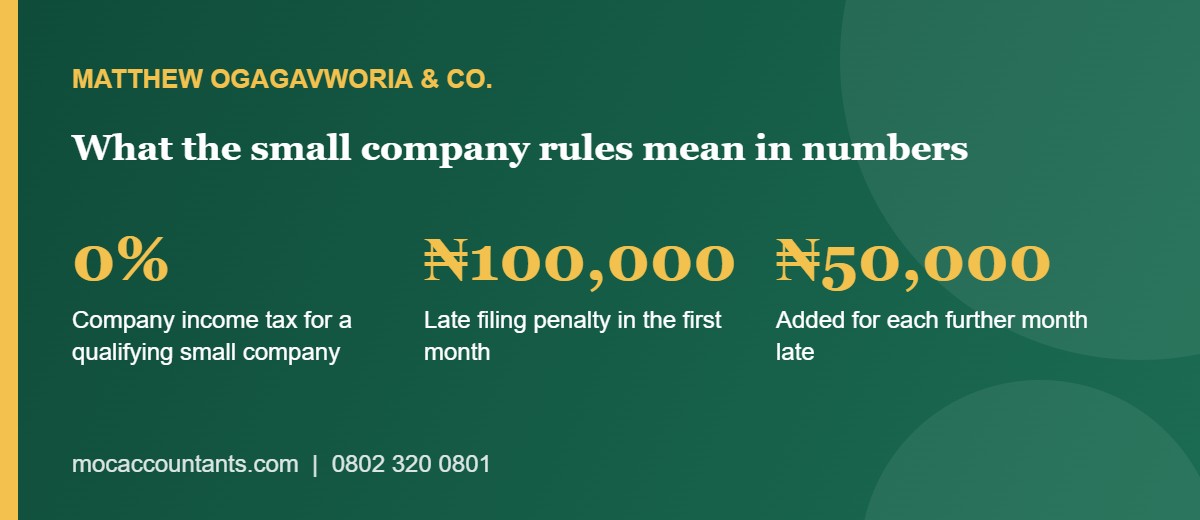
Small company tax rules in numbers. Source: Nigeria Tax Act 2025 and NRS guidance.
Who qualifies as a small company
Section 56 of the Nigeria Tax Act 2025 defines a small company. Two size tests apply at the same time:
Fixed assets below ₦250 million.
Annual gross turnover within the statutory limit. Most commentary and NRS-linked guidance cite ₦100 million. One major firm’s review of the final Act cites ₦50 million. Confirm the figure with your adviser against the gazetted Act before relying on it.
If you pass both tests, a qualifying small company pays:
0% company income tax on profits
0% capital gains tax
No 4% Development Levy
That is a real saving. A company with ₦30 million profit that would otherwise pay tax at the standard rate keeps all of it for reinvestment.
Who is excluded, whatever their size
This is where many owners get caught. The Act excludes businesses that provide professional services from the small company definition. Turnover and asset size do not matter.
If your main income comes from activities such as legal services, accounting and auditing, medical services, management consulting, architecture, engineering consultancy or IT consulting, you are likely outside the exemption. A two-person consultancy earning ₦15 million can still owe company income tax.
Mixed businesses need care. A company that sells products and also provides consulting must show which activity is primary. Poor classification invites a reassessment.
The tax reforms come with stronger data tools. NRS can compare your filings with bank records, payroll data and other filings. Here is what it is looking at.
1. Whether you filed at all. No return means no evidence you qualify. Late filing penalties under the new regime start at ₦100,000 for the first month and add ₦50,000 for each month after. A company that ignores filing for a year faces ₦650,000 in penalties before any tax is assessed. Read more in our guide to penalties for late tax filing in Nigeria.
2. Whether your turnover figure is believable. NRS can see inflows into business accounts. If your return shows ₦40 million turnover but your bank shows ₦140 million inflows, expect questions.
3. Whether loans were treated as revenue. NRS officials clarified in October 2026 that money received as a loan should not automatically be treated as sales or profit. This cuts both ways. You must be able to show loan agreements and repayment records. Without them, inflows look like income.
4. Whether personal and business money are mixed. At the Creative Africa Nexus session on 5 November 2026, NRS officials warned that many creators run substantial income through personal bank accounts without structured records. They also said personal expenses cannot be deducted as business costs unless they meet the legal tests.
5. Whether you are an excluded professional service. Expect NRS to look at your CAC objects, invoices and website descriptions. If your website says “consulting”, that is evidence.
6. E-invoicing and fiscalisation. Section 158 of the Act requires taxable persons making taxable supplies to adopt the fiscalisation system NRS deploys. Plan for system changes now.
What NRS has said it will not do
The reforms caused anxiety, much of it based on rumours. In October 2026 NRS publicly confirmed two points:
The standard VAT rate remains 7.5%.
The new laws do not authorise automatic deductions from personal bank accounts. Recovery must follow legal procedure.
Confirm your classification. Check your main activity against the professional services exclusion. Review your CAC registration, invoices and website wording.
Measure both size tests. Calculate gross turnover for the year and the cost of fixed assets. Keep the working papers.
Separate business and personal money. Open a dedicated business account if you have not. Move business receipts there.
Document loans and capital. Keep signed loan agreements, board resolutions and repayment schedules. Label inflows in your books.
File on time, even at 0%. Submit returns and supporting schedules by the deadline. A filed return at 0% is protection. A missing return is exposure.
When larger investment brings a tax credit
Growing companies should also know about a new incentive. NRS officials said in November 2026 that qualifying investments in eligible sectors, including the creative industry, can earn a 5% tax credit on capital expenditure of at least ₦250 million. Companies planning equipment, studios or plant in 2027 should structure and document the spend to qualify.
This is relevant for businesses that are about to outgrow the small company limits. Planning the transition well can reduce the tax shock of moving into the standard regime.
The Nigerian reality: cash, credit and compliance
Many Nigerian SMEs operate with thin margins and mixed records. Inflation fell to 14.63% in September 2026 and the Monetary Policy Rate is now 23%, so credit is getting cheaper. Lenders, development finance institutions and grant programmes almost always ask for tax clearance and filed returns.
The Afreximbank, Development Bank of Nigeria, NEXIM and SMEDAN arrangements worth $118 million for the creative economy, signed in Lagos on 6 November 2026, are one example. A business that cannot show filed returns and clean accounts will struggle to access that money. Tax compliance is now a funding requirement, not just a legal one. Our statutory audit services prepare the accounts lenders ask for.
Common mistakes we see
Assuming “0% tax” means “no return”.
Registering as a consultancy, then claiming the small company exemption.
Running all receipts through a director’s personal account.
Treating every inflow as sales, including loans and owner capital.
Relying on a turnover limit from a social media post rather than the Act.
Missing the first deadline and letting penalties grow.
A worked example: same size, different outcomes
Consider two Lagos companies. Each has ₦60 million turnover and ₦20 million in fixed assets.
Company A distributes building materials. It runs a dedicated business bank account, closes its books on time and files its return by the deadline. The return includes a computation showing turnover and fixed assets inside the limits. Company A pays 0% company income tax and no Development Levy. Its tax cost for the year is the fee for preparing the return.
Company B runs an IT consultancy. The owner reads that small companies pay no tax and files nothing. Twelve months later NRS matches its bank inflows and raises an assessment. Company B provides professional services, so it never qualified. It now owes full company income tax on its profit, ₦650,000 in late filing penalties for the year and interest on the unpaid tax.
The two companies are the same size. The difference lies in activity and records, and it runs into millions of naira.
Records to keep for every year you claim the exemption
NRS will ask you to prove both size tests and your business activity. Keep these on file:
Financial statements for the year, audited where the Companies and Allied Matters Act 2020 requires it
A fixed asset register showing cost, date of purchase and disposals
A turnover reconciliation that agrees the sales ledger to bank inflows
Loan agreements, board resolutions and records of capital injected by owners
Payroll records and evidence of PAYE remittances
VAT records, where you are registered
Copies of every return filed, with NRS acknowledgements
Growth is the goal, but crossing the turnover limit changes your tax position for that year. A company that moves past the limit pays full company income tax and the 4% Development Levy on its profits.
Watch turnover monthly from the third quarter. If you expect to cross the limit, act before year end:
Forecast profit and the tax that will fall due.
Time capital spending so that capital allowances work in your favour.
Set aside cash for tax each month rather than meeting it in one payment.
Review whether a group structure or separate activities make commercial sense, with proper advice.
A planned transition costs far less than a surprise assessment.
Frequently asked questions
Do small companies still file tax returns in Nigeria if they pay 0% tax?
Yes. NRS has confirmed that small companies must still file returns to show they qualify for the 0% rate.
Do I need an exemption certificate?
NRS officials said in November 2026 that small companies no longer need separate exemption certificates. Filing your return is how you show eligibility.
Are consulting firms small companies under the Nigeria Tax Act 2025?
Generally no. Businesses providing professional services are excluded from the small company definition regardless of turnover or assets.
What is the penalty for late filing?
₦100,000 in the first month and ₦50,000 for each month after.
Is VAT still 7.5%?
Yes. NRS confirmed in October 2026 that the standard VAT rate remains 7.5%.
Do small companies still remit PAYE in Nigeria?
Yes. The small company rules cover company income tax, capital gains tax and the Development Levy. PAYE on staff salaries must still be deducted and remitted monthly to the state tax authority.
How long should a small company keep tax records?
At least six years. Keep financial statements, the fixed asset register, bank reconciliations, loan documents and copies of filed returns.
How Matthew Ogagavworia & Co. can help
Matthew Ogagavworia & Co. (Chartered Accountants) helps Nigerian businesses confirm their tax classification, prepare and file returns, separate business records, and prepare audited accounts for lenders and investors. We work with clients in Lagos, Warri and across Delta State. See our tax consulting and business registration and compliance services.
Book a tax compliance review: call 0802 320 0801 or 0807 576 5799, email enquiry@mocaccountants.com, or visit mocaccountants.com/contact.
This article is general information and not a substitute for advice on your own facts.









Facebook Comments