Every statutory audit starts with a list. Auditors call it the PBC list, short for “prepared by client”. It sets out the schedules, reconciliations and documents the company must provide before the audit fieldwork can start.
How a company responds to that list decides how long the audit takes, how much it costs and how many queries come back. Companies that deliver a complete, accurate PBC pack in the first week often finish fieldwork in half the time of those that send documents piecemeal over two months. Delays push back the signing date, which in turn delays CAC annual returns, tax filings, bank renewals and dividend decisions.
This guide sets out the documents Nigerian companies should prepare for a statutory audit under CAMA 2020, how to organise them, and the common gaps that slow audits down. It is written for finance managers, accountants and owner-managers preparing for a December year-end audit.
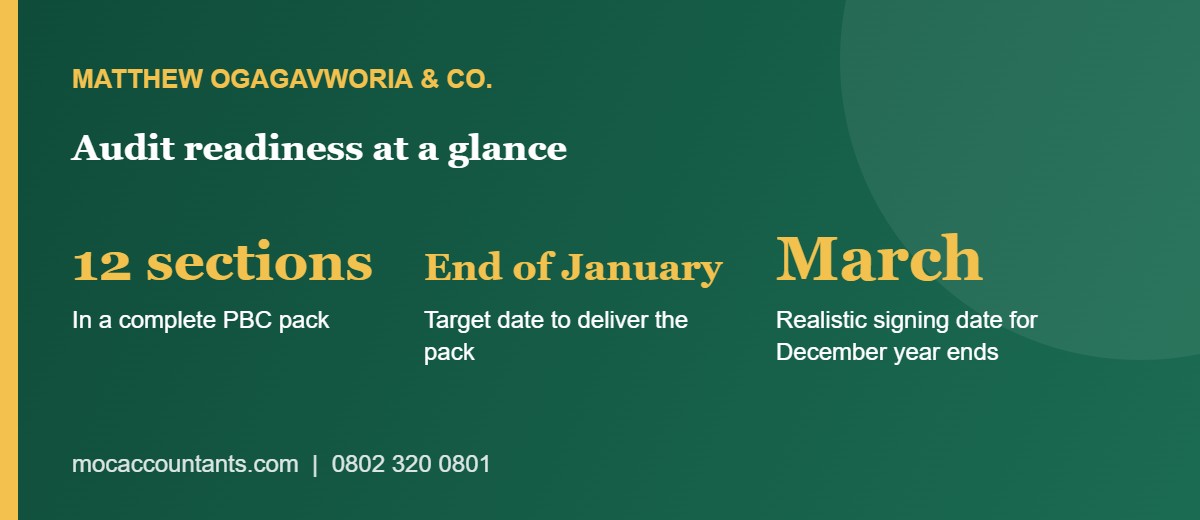
Audit readiness timetable for December year-end companies.
Why preparation matters more under current rules
Three developments raise the stakes for audit preparation in 2027.
Tax reform. The Nigeria Tax Act 2025 took effect on 1 January 2026, with new rules on company income tax, the 4% Development Levy, small company exemptions and capital gains. The first full year under the new regime ends on 31 December 2026. Auditors will test tax computations and deferred tax balances closely, and they will need clear workings.
Regulatory scrutiny. The Financial Reporting Council of Nigeria continues to focus on audit quality and on the quality of financial statements filed by public interest entities. Auditors under quality review ask for more evidence than they did five years ago.
Lender and investor demands. Banks, development finance institutions and investors increasingly require audited accounts within set periods after year end. Late accounts can breach loan covenants.
The core PBC list
The exact list depends on the company’s size and industry, but most audits require the following.
List of related parties and transactions during the year.
Balances due to and from directors, shareholders and group companies.
Details of significant events after year end.
How to organise the PBC pack
A well-organised pack saves time for both sides.
Use one folder per section. Match the numbering above or your auditor’s list.
Index every document. A simple spreadsheet listing each item, its file name and status works well.
Agree every schedule to the trial balance. Auditors start by checking that schedules tie to the ledger. Unreconciled schedules generate immediate queries.
Provide workings, not just results. Show how provisions, accruals and tax figures were calculated.
Use a secure shared folder. Avoid sending sensitive files by personal email.
Assign an owner for each section. One person in finance should coordinate and track responses.
A realistic audit timetable
Week
Activity
November
Agree audit plan, timetable and PBC list with the auditor
31 December
Year-end stock count and cash count
January weeks 1 to 3
Close the books, prepare reconciliations and schedules
January week 4
Deliver the complete PBC pack
February
Audit fieldwork and query resolution
March
Draft financial statements, management letter and representation letter
March to April
Board approval and signing
Companies that close their books within three weeks and deliver the pack by the end of January can usually sign by March.
The gaps that slow audits most
From our audit work, the same issues cause most delays:
Bank reconciliations with old reconciling items. Uncleared items from months ago need investigation before the auditor can rely on the balance.
No fixed asset register. Without a register, the auditor cannot verify assets or depreciation.
Unsupported journals. Large manual journals without explanation or approval attract detailed testing.
Director current accounts. Personal expenses paid by the company and undocumented loans need clear schedules and board approval.
Missing tax evidence. Receipts for tax payments and filed returns are often scattered.
Unreconciled intercompany balances. Group companies record different amounts for the same balance.
Fixing these before the audit starts saves weeks.
A worked example
A Warri oilfield services company with ₦2.8 billion turnover had signed its last two audits in September, nine months after year end. Its bank complained that late accounts breached its facility terms.
For the next audit, the finance team agreed a timetable with the auditor in November, cleaned up bank reconciliations monthly, built a fixed asset register from invoices and site verification, and assigned one accountant to coordinate the PBC pack. They delivered 92% of requested items by the end of January.
Fieldwork took three weeks instead of eleven. The accounts were signed in March. The bank renewed its facility on better terms, and the company filed its tax return early.
Details have been changed to protect client confidentiality.
Month-end discipline makes year end easy
Most audit delays start long before year end. Companies that close their books properly every month arrive at December with clean balances and few surprises. A monthly close checklist should include:
Bank reconciliations for every account, with old items cleared.
Debtors and creditors ledgers agreed to control accounts.
Supplier statement reconciliations for the top ten suppliers.
Fixed asset additions and disposals posted and depreciation run.
Payroll reconciled and PAYE, pension and NHF remitted.
VAT and withholding tax returns filed and paid.
Accruals and prepayments reviewed.
Intercompany balances agreed with group companies.
Management accounts reviewed by the finance manager and owner.
If these steps happen every month, the year-end PBC pack becomes a matter of printing and indexing schedules that already exist.
Communicating with your auditor
Good audits rely on good communication. Agree a single point of contact on each side. Hold a short weekly meeting during fieldwork to review open queries and agree deadlines. Raise difficult issues early, such as a large bad debt, a disputed tax assessment or a significant new contract. Auditors respond better to issues raised by management than to issues they discover late.
At the end of the audit, review the management letter carefully. It lists control weaknesses and recommendations. Assign owners and deadlines for each point, and report progress to the board or audit committee. Points that repeat year after year signal that the finance function needs support.
Documents that need director sign-off
Directors carry legal responsibility for the financial statements under CAMA 2020. Before signing, the board should receive and approve:
The final financial statements and directors’ report.
The management representation letter to the auditor.
Key judgements, such as provisions, impairments and going concern assessments.
The auditor’s management letter and management’s responses.
Board minutes should record the approval and any matters discussed. Signing without review exposes directors to personal risk if the accounts later prove misleading.
Frequently asked questions
What is a PBC list in an audit?
A “prepared by client” list sets out the schedules, reconciliations and documents a company must provide to its auditor so that audit fieldwork can proceed.
When should we start preparing for a December year-end audit?
Agree the audit plan and PBC list in November, run the stock and cash counts on 31 December, and aim to deliver the complete pack by the end of January.
Why do auditors ask for bank statements after year end?
Post year-end bank statements help auditors confirm that reconciling items cleared and that liabilities and receipts were recorded in the right period.
What happens if our audit is delayed?
Delays can breach loan covenants, delay CAC annual returns and tax filings, and increase audit fees because of extra time spent on queries.
Do small companies need a statutory audit?
CAMA 2020 exempts qualifying small companies from audit, but many still need audited accounts for banks, investors, tenders or tax purposes. Check whether your company qualifies and whether stakeholders require an audit.
Who signs the financial statements in Nigeria?
The board of directors approves and signs the financial statements under CAMA 2020, usually through at least two directors, along with the auditor’s report signed by the audit firm.
How Matthew Ogagavworia & Co. can help
Matthew Ogagavworia & Co. (Chartered Accountants) provides statutory audits, audit readiness reviews, accounts preparation and tax compliance for companies in Lagos, Warri and across Nigeria. We help clients prepare their PBC pack, clean up reconciliations and fixed asset registers, and complete audits on time. See our statutory audit services, external audit and accounting services.
Plan your 2026 audit: call 0802 320 0801 or 0807 576 5799, email enquiry@mocaccountants.com, or visit mocaccountants.com/contact.
This article is general information, not a substitute for advice on your own facts.











Facebook Comments