


Most Nigerian businesses never read their bank statements line by line. The bank sends them, the accounts team files them, and the balance moves on. That habit costs money. Account maintenance fees charged above the cap, interest at rates nobody agreed, duplicated charges and debits with narrations such as “VIDE UNKNOWN” or “LENDER CHARGES” can drain a company account for years before anyone asks a question.
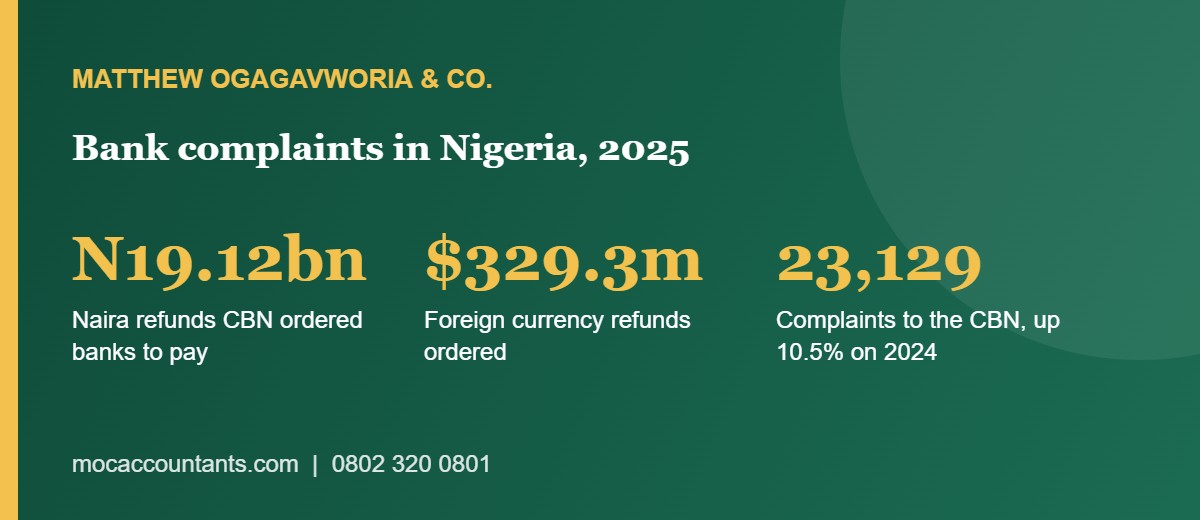
The numbers show how common this is. The Central Bank of Nigeria (CBN) received 23,129 consumer complaints in 2025, up 10.5% on 2024. It ordered banks to refund N19.12 billion and $329.3 million to customers in the same year, according to Legit.ng’s summary of the CBN 2025 Annual Report. Those refunds only went to customers who complained. Many more never checked.
This guide explains how excess bank charges arise, how a forensic accountant rebuilds an account to prove them, how to recover the money, and what an expert witness does when the dispute reaches court.
What counts as an excess or illegal bank charge
A bank may only charge what the CBN Guide to Charges by Banks permits, or what the customer has agreed in writing within those limits. Anything outside that is open to challenge. The common problems fall into six groups.
| Problem | What it looks like on a statement |
|---|---|
| Fees above the CBN cap | Account maintenance fee above N1 per N1,000 of customer-induced debits on a current account |
| Interest above the agreed rate | Overdraft or loan interest higher than the offer letter, or rate increases with no written notice |
| Compounding not agreed | Interest charged on unpaid interest where the facility letter does not allow it |
| Duplicated charges | The same fee, SMS alert or transfer charge debited twice |
| Unexplained debits | Narrations such as “VIDE”, “LENDER”, “ADJ” or “REVERSAL” with no matching instruction or advice |
| Charges after closure or repayment | Fees and interest still running after a loan was repaid or an account closed |
Some of these are plain errors. Some come from system settings that were never corrected. A few are deliberate. The customer does not need to prove which. The question is whether the bank had a contractual or regulatory right to take the money. If it did not, the money is recoverable.
The rules banks must follow
The current framework is the CBN Guide to Charges by Banks, Other Financial and Non-Bank Financial Institutions, effective from 1 January 2020. It sets maximum fees for account maintenance, transfers, card issuance, cheque services and lending charges. Banks may charge less. They may not charge more without CBN approval.
In 2026 the CBN released a draft revision. The Guardian reported that the draft keeps electronic transfers below N5,000 free, caps interbank transfer fees at N50, requires loan pricing to be quoted as an annual percentage rate including all fees, and requires advance notice before banks change agreed lending rates. It also says any charge not listed in the guide needs prior CBN approval. The draft is not yet final, so the 2020 guide still governs past charges.
The CBN has also said for years that excess charges must be refunded with interest. A CBN consumer protection official confirmed this position in 2018, as reported by Business Post.
Two other sources of rights matter:
- The facility letter or account mandate. This sets the agreed interest rate, the fees, the default rate and how changes are notified. A charge that breaks the contract is recoverable even if it sits within the CBN cap.
- The CBN consumer protection framework. Banks must disclose charges, handle complaints within set timelines and give customers a tracking number for each complaint.
Why businesses miss excess charges
Excess charges rarely show up as one large, obvious debit. They hide in volume. A company with five accounts and 2,000 transactions a month may have 300 charge lines every month. Each one is small. Over five years they add up to millions of naira.
Other reasons we see in practice:
- No reconciliation of charges. Accounts teams reconcile balances, not individual fees.
- Lost facility letters. Nobody can say what rate was agreed, so nobody can say the bank charged too much.
- Rate changes by notice on a website. Banks change rates and the customer never sees the notice.
- Cryptic narrations. Entries marked “VIDE” or “LENDER” with no counterparty look official and go unchallenged.
- Fear of the relationship. Some businesses worry that a complaint will hurt their credit lines.
How a forensic accountant rebuilds the account
A forensic review does what the bank’s system should have done. It recalculates every charge from first principles and compares the result with what the bank actually debited. The work follows a fixed sequence.
1. Collect the evidence
Gather full bank statements for every account in scope, for the whole period under review. Request certified copies from the bank where needed. Collect facility letters, offer letters, variation notices, account opening mandates, board resolutions on borrowing and all correspondence with the bank.
2. Convert statements into data
Paper and PDF statements go into a structured dataset. Each line keeps its date, value date, narration, debit, credit and running balance. The analyst checks that the running balance rolls forward without breaks. A gap in the balance usually means missing pages or a hidden reversal.
3. Classify every debit
Each debit is tagged by type: customer payment, bank fee, interest, VAT on fees, reversal, or unexplained. The unexplained group gets special attention. Narrations such as “VIDE UNKNOWN”, “LENDER CHARGES” or “MISC DR” with no supporting advice are listed separately and put to the bank for explanation.
4. Recalculate charges and interest
The analyst rebuilds each fee using the CBN cap in force at the time and the rate in the facility letter. Interest is recalculated on the actual daily balance at the agreed rate, using the agreed day-count and compounding basis. Where the bank changed the rate, the analyst checks whether the customer was notified as the contract required.
5. Quantify the excess
The difference between what the bank charged and what it was entitled to charge is the excess. VAT charged on the excess fee is also recoverable. The analyst then computes interest on the excess from the date of each wrongful debit to the date of the report.
6. Report the findings
The report sets out the method, the sources, the assumptions, each category of excess, and a schedule that links every naira of the claim to a statement line. A clear report is what makes a bank pay.
A worked example
The figures below are illustrative only. They show how a review builds up a claim.
A Lagos distribution company runs a current account and an overdraft with one bank from 2021 to 2025. Customer-induced debits average N2.4 billion a year.
| Item | Bank charged (5 years) | Entitled to charge | Excess |
|---|---|---|---|
| Account maintenance fee | N20.5m | N12.0m | N8.5m |
| VAT on excess fee at 7.5% | N0.6m | ||
| Overdraft interest (bank applied 32% against 27% agreed) | N96.0m | N81.0m | N15.0m |
| Duplicated SMS and transfer charges | N1.1m | N0 | N1.1m |
| Unexplained “VIDE” and “LENDER” debits | N3.2m | N0 | N3.2m |
| Total excess before interest | N28.4m |
The company recovers N28.4 million plus interest on each excess from the date it was debited. The bank may produce documents that justify part of the unexplained debits. Those lines then drop out of the claim. The rest stands.
How to recover excess charges
Recovery follows a ladder. Start at the bottom and move up only when the bank does not respond.
- Write to the bank. Send the forensic report with a formal demand for refund and interest. Address it to the relationship manager and the bank’s complaints unit. Keep proof of delivery.
- Get a tracking number. The bank must acknowledge the complaint and issue a tracking number. If it does not acknowledge within three days, you can escalate.
- Escalate to the CBN. If the bank fails to resolve the complaint within the regulatory timeline, write to the Director, Consumer Protection Department, CBN, with the report, the demand letter and the bank’s response. The CBN complaints page sets out the current process.
- Negotiate. Many banks settle once they see a detailed, line-by-line reconstruction. A settlement can cover the refund, interest and a reset of the facility terms.
- Go to court. Where the sum is large or the bank refuses, litigation is the final route. This is where a forensic accountant’s report becomes evidence and the accountant becomes an expert witness.
Watch the time limit. Claims in contract are subject to limitation laws, which in Lagos generally allow six years for simple contract claims. Older charges may be out of time. Take legal advice early on how far back you can claim.
Fraud and unauthorised debits are a different matter
Not every wrongful debit is an overcharge. Some are fraud. Typical patterns include:
- transfers out of the account that no authorised signatory approved
- debits that match a staff member’s personal account or a related company
- reversals that move money out and never return it
- cheques or e-mandates processed on forged or altered instructions
Here the forensic task widens. The accountant traces where the money went, identifies who initiated each transaction, and checks the bank’s own controls. Was the mandate followed? Did the bank verify the signature or the token? Was a callback made on a large transfer? Where the bank breached its duty of care, it may have to restore the funds even if an outsider committed the fraud. Where an insider is involved, the evidence may also support a criminal complaint to the police or the EFCC.
The forensic accountant as expert witness
When a bank dispute reaches court, the judge needs help with the numbers. That is the expert witness’s role. The expert is not an advocate for the client who pays the fee. The duty runs to the court.
A credible expert witness:
- Stays inside their expertise. A forensic accountant gives opinions on calculations, records and accounting practice, not on what the law means.
- Shows the working. Every figure in the report must trace back to a document the court can see.
- States the assumptions. Where a facility letter is missing or a rate is unclear, the expert says what assumption was used and how the result changes if it is wrong.
- Deals with the other side’s figures. A good report explains why the bank’s computation differs and where it goes wrong.
- Stands up to cross-examination. Opposing counsel will test the method, the data and the expert’s independence. Clear, plain answers win credibility.
Getting the evidence admitted
Bank statements and spreadsheets are electronic records. Under section 84 of the Evidence Act 2011, a party relying on computer-generated documents generally needs a certificate covering the device and process that produced them. The Evidence (Amendment) Act 2023 widened the treatment of electronic records. Courts have rejected bank statements and schedules for missing certificates, so the legal team and the expert should plan this from the start. ThisDay’s March 2026 review of how courts treat electronic bank statements is a useful starting point for counsel.
What makes an expert report persuasive
- A short executive summary with the total claim and its components
- A method section a non-accountant can follow
- Schedules that link every figure to a statement page and line
- A reconciliation to the bank’s own figures
- A clear statement of independence and qualifications
Common mistakes businesses make
Relying on incomplete statements. Missing months break the recalculation. Request certified statements for the full period before work starts.
Claiming without the facility letter. Without the agreed terms, interest claims rest on assumptions. Search your records, your lawyer’s files and the board minutes first.
Sending an angry letter instead of a report. A complaint that says “you overcharged us” gets a standard reply. A complaint with a line-by-line schedule gets attention.
Using an expert who also acts as advocate. Courts discount experts who argue the client’s case. Choose someone whose report will survive cross-examination.
Waiting too long. Every year of delay pushes old charges past the limitation period.
Prevention: controls that stop overcharging
- Monthly charge review. Extract all bank fee and interest lines each month and compare them with the agreed tariff.
- Facility register. Keep every facility letter, rate notice and variation in one place, with the agreed rate and fees summarised.
- Interest recalculation. Recompute interest on large facilities each quarter. Small differences compound.
- Query every unexplained debit. Any narration without a clear counterparty or instruction gets a written query within the month.
- Annual independent review. For businesses with heavy borrowing or high transaction volumes, an annual forensic check of bank charges costs far less than five years of losses.
For a wider view of fraud controls, see our guides on forensic accounting and fraud investigation and fraud recovery and financial restitution.
Frequently asked questions
How do I know if my bank has charged me excess fees?
Compare each fee and interest charge on your statements with the CBN Guide to Charges by Banks and your facility letter. Differences in account maintenance fees, interest rates, duplicated charges and unexplained debits are the usual signs. A forensic review recalculates every charge to confirm the excess.
Can I get interest on refunded bank charges?
Yes. The CBN has said excess charges should be refunded with interest. In a negotiated settlement or court claim, interest is usually computed from the date of each wrongful debit.
What does “VIDE” mean on a Nigerian bank statement?
It is a reference word meaning “by way of” or “see”. On its own it explains nothing. A debit marked “VIDE” or “LENDER” with no matching instruction or advice should be queried in writing.
What does a forensic accountant do as an expert witness?
The expert prepares an independent report on the figures in dispute, explains the method to the court and answers questions under cross-examination. The expert’s duty is to the court, not to the client.
How far back can I claim excess bank charges?
It depends on the limitation law that applies. In Lagos, simple contract claims are generally limited to six years. Take legal advice early, because charges older than the limit may be out of time.
How Matthew Ogagavworia & Co. can help
Matthew Ogagavworia & Co. carries out forensic reviews of bank accounts and loan facilities, recalculates charges and interest, quantifies excess and unauthorised debits, and prepares reports that support refund claims, CBN complaints and litigation. Our forensic accountants also act as expert witnesses in bank disputes. See our audit services, legal and regulatory advisory and debt recovery services.
To book a bank charges review, call 0802 320 0801 or 0807 576 5799, email enquiry@mocaccountants.com, or visit our contact page.
This article is general information based on public sources available on 11 November 2026. It is not legal advice. The worked example is illustrative. Speak to a qualified legal practitioner about limitation periods and litigation strategy for your case.




Facebook Comments