Most Nigerian companies close their financial year on 31 December. For any business that holds inventory, that date brings one of the most important tasks of the year: the year-end stock count. It confirms what the company owns, supports the closing inventory figure in the financial statements, and gives the auditor evidence that the number is real.
A poor count causes problems that last for months. Auditors may qualify their opinion. Tax authorities may challenge cost of sales. Management may make decisions on stock levels that do not exist. And losses from theft or damage stay hidden for another year.
This guide explains how to plan and run a year-end stock count in Nigeria, what your auditor will look for when they attend, and how to resolve differences before the books close. It draws on our experience counting stock for manufacturers, distributors, retailers, telecoms companies and oil and gas service firms across Lagos, the South West and the Niger Delta.
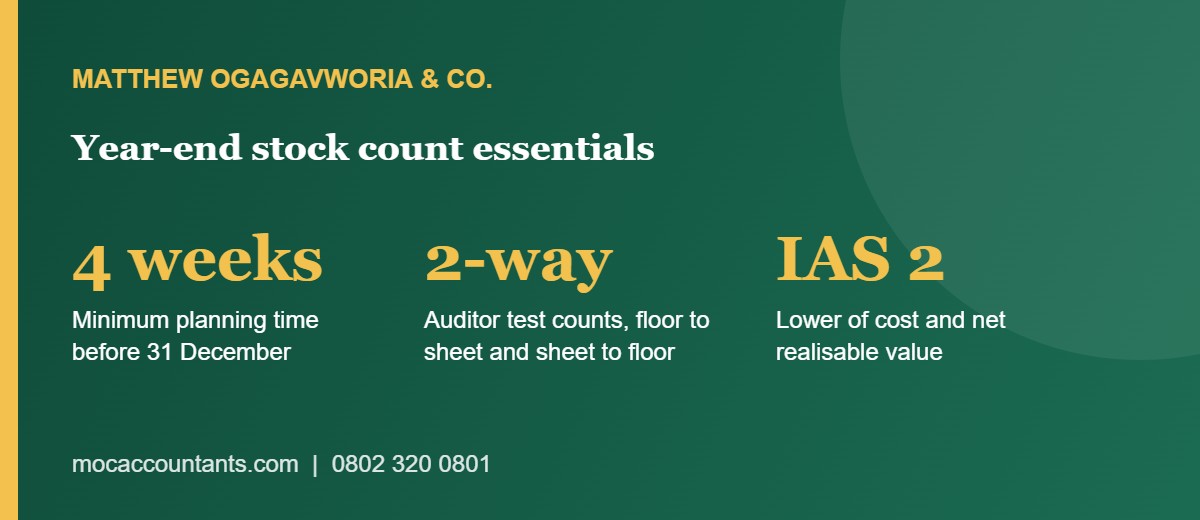
Year-end stock count essentials for Nigerian companies.
Why the year-end count matters
It supports the financial statements. Inventory is often one of the largest assets on the balance sheet of a trading or manufacturing company. Under IAS 2, inventory is measured at the lower of cost and net realisable value. The count establishes the quantities. Without reliable quantities, the valuation means nothing.
Auditors must attend. International Standards on Auditing require auditors to attend the physical count where inventory is material, unless that is impracticable. Their attendance lets them observe procedures, perform test counts and inspect the condition of stock. If they cannot obtain enough evidence, they may modify their opinion.
It drives cost of sales and profit. Cost of sales equals opening stock plus purchases minus closing stock. An overstated closing stock overstates profit and tax. An understated closing stock does the opposite. Tax authorities know this and review stock movements during tax audits.
It reveals losses. Differences between the count and the stock records point to theft, damage, recording errors or supplier short deliveries. Finding them at year end is better than never finding them.
Plan at least four weeks ahead
A good count is mostly planning. Start in late November for a 31 December count.
Agree the date and cut-off
Decide whether to count on the year-end date or on a nearby date with a roll-forward or roll-back to year end. Counting on 31 December is cleanest. If you count earlier, you must reconcile movements between the count date and year end, and your auditor will test that reconciliation.
Set a clear cut-off. Stop receiving and dispatching goods during the count where possible. Where operations cannot stop, record the last goods received note and dispatch note numbers before the count starts, and the first numbers after it ends.
Prepare the stock records
Clean the stock records before the count:
Post all receipts, issues, transfers and returns up to the cut-off.
Resolve negative stock balances in the system.
Update item codes and descriptions so counters can identify items.
Print or load count sheets by location, with item code, description and unit of measure, but without system quantities. Blind counts are more reliable.
Organise the warehouse
A tidy warehouse counts faster and more accurately:
Arrange stock by item, with labels visible.
Separate damaged, obsolete, slow-moving and returned goods into marked areas.
Identify goods held for customers, goods on consignment and goods belonging to others. These should be excluded from your count.
Identify your goods held elsewhere, such as at distributors, third-party warehouses or in transit. Arrange confirmations or separate counts.
Write count instructions
Written instructions keep every team consistent. They should cover:
Count areas and team assignments.
How to count and record each type of item, including bulk materials and partial packs.
How to mark counted items or locations to avoid double counting.
How to record damaged or obsolete stock.
Cut-off procedures and document numbers.
Who resolves queries and how recounts work.
Share the instructions with your auditor in advance. They will review them and may suggest changes.
Running the count
Count teams
Use teams of two: one counts, one records. Where possible, use staff who do not handle the stock day to day, or pair a storekeeper with someone independent. Independent counters reduce the risk that errors or theft are concealed.
Counting methods
Stock type
Method
Boxed or packed goods
Count full cartons, then open and count partial cartons
Bulk materials such as cement, grain or diesel
Weigh, measure tank dips or use agreed conversion tables
Spare parts and small items
Count individually, use bin cards as a reference only
Work in progress
Assess stage of completion with production staff
Telecoms and electronic devices
Scan serial numbers and match to records
Control the count sheets
Number every count sheet and issue them under control. Record which team has which sheets. At the end, collect every sheet, including spoiled ones. Missing sheets are a warning sign.
Recounts
Compare counts to system records after the count, not during it. Investigate large differences with recounts by a different team before anyone leaves the site. A recount on the day is far more reliable than an explanation weeks later.
What your auditor will do
Expect your auditor to:
Review the count instructions and observe whether teams follow them.
Perform test counts in two directions: from the floor to the count sheets, and from the count sheets to the floor.
Inspect stock for damage, obsolescence and slow movement.
Record cut-off document numbers and test them later against the accounts.
Obtain copies of count sheets or summaries.
Ask about stock held by third parties and stock belonging to others.
Auditors will note weaknesses in their management letter. Common points include poor segregation of damaged stock, uncontrolled count sheets and weak cut-off.
After the count: reconciliation and valuation
Reconcile differences
Compare final counts to the stock records and investigate significant differences. Typical causes include:
Unposted receipts or issues near the cut-off.
Wrong units of measure, such as cartons recorded as pieces.
Items recorded under the wrong code.
Goods sent to customers but not invoiced, or invoiced but not sent.
Theft or unrecorded damage.
Post adjustments only with proper approval and documentation. Large unexplained losses need management attention and may need investigation.
Value the stock
Apply your costing method consistently, such as weighted average or first-in, first-out. Then test for net realisable value. Write down stock that is damaged, obsolete, expired or selling below cost. In 2026, with input costs rising and consumer demand weak in some categories, net realisable value testing deserves extra care. Products that sold well two years ago may now sit unsold.
Imported stock needs attention to exchange rates. Inventory is recorded at historical cost in naira at the date of purchase, not revalued at the year-end exchange rate. Costs such as freight, duties and clearing charges form part of inventory cost.
A worked example
A Lagos distributor of household goods counted stock on 31 December. Its system showed stock of ₦486 million. The count found stock worth ₦451 million at cost.
Investigation explained most of the ₦35 million difference:
₦14 million of goods dispatched on 31 December had been counted as delivered but the invoices were posted on 2 January. A cut-off correction resolved this.
₦9 million related to cartons recorded as pieces for three product lines. A units correction resolved this.
₦5 million was damaged stock already set aside but not written off in the system.
₦7 million remained unexplained. Further review found repeated short deliveries from one supplier that the storekeeper had signed for in full.
The company corrected the records, wrote down the damaged stock, claimed credit from the supplier, and changed its receiving procedure to require weighbridge tickets and supervisor sign-off.
Figures are illustrative.
Stock held by third parties
Many Nigerian businesses hold stock at distributors’ warehouses, in bonded warehouses, at ports awaiting clearance, or with contract manufacturers. This stock still belongs to you and must be counted or confirmed.
Options include:
Arranging a separate count with your staff or an independent counter at each location.
Obtaining written confirmation of quantities from the third party as at year end.
Reviewing shipping documents for goods in transit.
Auditors usually want more than a confirmation for material balances. Plan these counts early, especially in locations outside Lagos.
Counting with system quantities on the sheets. Counters copy the system number instead of counting.
No cut-off control. Goods move during the count and are counted twice or not at all.
Counting goods that belong to others. Consignment stock and customer goods awaiting collection inflate inventory.
Ignoring damaged and obsolete stock. These items are counted at full value.
Leaving before recounts. Differences are explained away later with weak evidence.
Not involving the auditor early. Last-minute changes cause delays and qualifications.
Sector-specific points
Manufacturers must count raw materials, packaging, work in progress and finished goods separately. Agree the stage of completion for work in progress with production managers before the count, and document the basis.
Distributors and wholesalers often hold stock in several depots and vans. Count van stock at the end of the last trading day, and confirm stock held by sub-distributors.
Retailers with many outlets should count high-value and fast-moving lines in every store, and use a sample approach for low-value lines only where the auditor agrees.
Telecoms and technology companies hold devices, SIM cards, routers and network equipment at warehouses, base stations and partner shops. Serial number scanning speeds up the count and supports later tracking.
Oil and gas service companies hold spares, consumables and chemicals at yards, bases and offshore locations. Plan logistics and safety approvals early, because access to some sites takes weeks to arrange.
Restaurants and hotels hold perishable stock. Count food, drinks and consumables after the last service, and record expired items for write-off.
Using technology to count faster
Barcode scanners and mobile count apps cut counting time and transcription errors. Counters scan each item and enter the quantity on a handheld device, and results upload directly for reconciliation. For companies with thousands of item lines, this can reduce a two-day count to one. Test the devices and data upload before count day, keep paper backups, and agree with your auditor how they will perform test counts on scanned data.
Frequently asked questions
Why do auditors attend stock counts?
International Standards on Auditing require auditors to attend physical inventory counts where inventory is material, so they can observe procedures, perform test counts and inspect stock condition.
Can we count stock before 31 December?
Yes. You can count on a nearby date and roll the quantities forward or back to year end. Your auditor will test the movements between the count date and year end, so records must be accurate.
What is a blind count?
A count where the count sheets show item codes and descriptions but not the quantities recorded in the system. It stops counters from copying system figures.
How should damaged or obsolete stock be treated?
Separate it before the count, record it separately, and write it down to net realisable value under IAS 2.
Should we use an independent stock counter?
An independent counter adds objectivity, speed and expertise, especially for large or multi-location counts, and gives auditors more confidence in the results.
How long does a year-end stock count take?
It depends on the number of items and locations. A single warehouse with a few hundred lines can be counted in a day. Multi-location counts with thousands of lines may take two or three days with several teams.
How Matthew Ogagavworia & Co. can help
Matthew Ogagavworia & Co. (Chartered Accountants) provides independent stock count teams, count planning, reconciliation and inventory valuation support for companies across Nigeria. We have counted stock at warehouses, retail outlets, telecoms sites and industrial locations. See our stock counter services, inventory management services and statutory audit services.
Book your year-end count now: call 0802 320 0801 or 0807 576 5799, email enquiry@mocaccountants.com, or visit mocaccountants.com/contact.
This article is general information, not a substitute for advice on your own facts.










Facebook Comments