Every January, employers across Nigeria rush to file their annual returns of employees’ emoluments with state tax authorities. Many miss the deadline. Others file returns that do not match their monthly PAYE remittances, which invites queries, back-duty assessments and penalties.
The January 2027 filing season carries extra risk. It covers 2026, the first year under the Nigeria Tax Act 2025. PAYE bands, reliefs and computations changed on 1 January 2026, and state tax authorities will compare employers’ annual returns with what they expect under the new rules. Employers that applied the new rules inconsistently during the year will find the differences exposed.
This guide explains what employers must file, when, how to reconcile the return with monthly remittances, and how to avoid the errors that trigger tax audits.
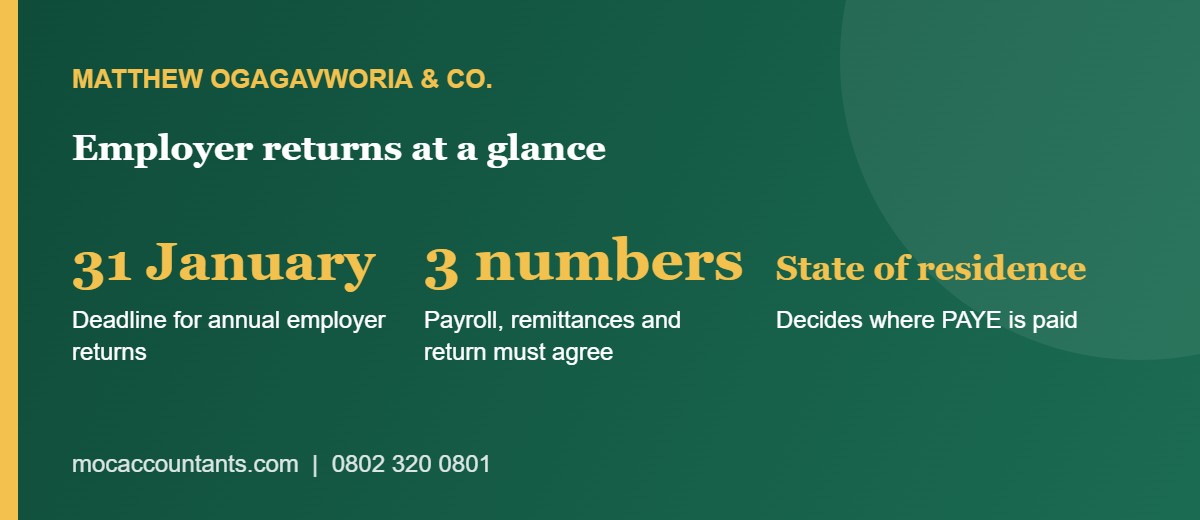
Key points for the January 2027 employer filing season.
What the annual employer return is
Employers deduct PAYE from employees’ pay each month and remit it to the state tax authority where each employee is resident. Once a year, the employer must also file a return showing, for every employee, the total pay, deductions, reliefs and tax deducted during the previous year.
In Lagos State, this is commonly known as Form H1, filed with the Lagos State Internal Revenue Service. Other states have their own forms and portals, but the content is similar. The deadline is generally 31 January following the end of the year.
The return lets the tax authority check that every employee was taxed correctly, that the employer remitted what it deducted, and that employee records match other data such as pension and bank records.
Who must file
Every employer that pays emoluments to employees in Nigeria must file, including:
Companies of all sizes, including small companies exempt from company income tax.
Partnerships and sole proprietors with employees.
NGOs, schools, churches and other non-profit employers.
Government agencies and parastatals.
Foreign companies with staff in Nigeria.
Being exempt from company income tax does not remove the duty to operate PAYE and file employer returns. A small company paying 0% company income tax must still deduct and remit tax on its employees’ salaries.
Full name, tax identification number and contact details.
Designation and dates of employment, including starters and leavers during the year.
Gross emoluments, broken down into basic salary, allowances and benefits in kind.
Pension contributions, National Housing Fund contributions and other deductible items.
Reliefs claimed, including rent relief under the Nigeria Tax Act 2025.
Taxable income and total PAYE deducted.
Total PAYE remitted, with dates and receipt references.
The return usually includes a summary schedule showing monthly remittances and payment evidence.
The 2026 changes that affect your return
Personal income tax for 2026 follows the Nigeria Tax Act 2025:
The first ₦800,000 of annual taxable income is taxed at 0%.
Higher bands are taxed at 15%, 18%, 21%, 23% and 25%, with 25% applying above ₦50 million.
The consolidated relief allowance no longer applies.
Rent relief of 20% of annual rent paid, capped at ₦500,000, is available with evidence.
Pension, NHF and qualifying health insurance contributions remain deductible.
Your annual return must reflect these rules for the full year. If your payroll system applied the new bands late, or applied rent relief without evidence, the return will show inconsistencies.
Reconcile before you file
The most important step is reconciliation. Before submitting the return, check that three numbers agree:
PAYE per payroll. The total tax deducted according to the payroll register for January to December.
PAYE remitted. The total paid to each state tax authority, according to bank statements and receipts.
PAYE per annual return. The total shown on the return.
Differences usually arise from:
Months where remittances were late or missed.
Staff resident in one state but taxed in another.
Bonuses or arrears paid outside the normal payroll.
Benefits in kind not included in taxable pay.
Leavers whose final pay or terminal benefits were processed separately.
Errors in applying the new 2026 bands or reliefs.
Investigate and correct each difference. Pay any shortfall, with interest where applicable, before the tax authority finds it.
State of residence matters
PAYE is remitted to the state where the employee is resident, not necessarily where the employer’s head office sits. A company headquartered in Lagos with staff living in Ogun State must remit those employees’ PAYE to the Ogun State Internal Revenue Service and file returns there.
Errors in residence cause double taxation disputes and penalties. Keep up-to-date address records for every employee, and review them when staff relocate. This issue is common for companies with operations in Lagos and Ogun, in Abuja and Nasarawa, and in Rivers and Delta.
Other year-end payroll obligations
The PAYE return is not the only January deadline. Review all payroll-related obligations at the same time:
Obligation
Who
Key point
Pension contributions
Employers with three or more staff
Remit monthly to each employee’s PFA under the Pension Reform Act 2014
National Housing Fund
Employers of eligible employees
Remit contributions deducted from qualifying employees
Industrial Training Fund
Employers meeting the ITF Act thresholds
Contribution of 1% of annual payroll, with annual returns
Employees’ Compensation (NSITF)
All employers
Employer contribution of 1% of total monthly payroll
Annual employer return
All employers
File with each relevant state tax authority by 31 January
Compliance certificates from PenCom, ITF and NSITF are often required for government contracts and tenders. Missing filings can cost you business as well as penalties.
Employees need tax clearance certificates for many purposes, including visa applications, property purchases and public appointments. State tax authorities issue them based on the employer’s returns and remittances. When employers fail to file or remit, employees cannot get clearance, and staff morale suffers. Timely filing is part of being a good employer.
A worked example
A Lagos technology company with 85 staff prepared its annual return in January. Payroll showed PAYE deducted of ₦96.4 million for the year. Bank records showed remittances of ₦91.2 million.
The ₦5.2 million gap came from three sources:
₦2.6 million: December PAYE remitted on 14 January, after the year-end bank cut-off. This was a timing difference with no exposure.
₦1.8 million: tax on a mid-year performance bonus paid through a separate payment run and never remitted.
₦0.8 million: twelve employees resident in Ogun State whose PAYE had been remitted to Lagos.
The company remitted the bonus tax with interest, corrected the residence records, applied to Lagos for a refund or offset of the misdirected tax, and remitted the correct amount to Ogun. Its return was filed on 27 January with a full reconciliation attached.
Figures are illustrative.
Common mistakes
Filing a return that does not reconcile to monthly remittances.
Ignoring staff resident in other states.
Excluding bonuses, arrears or benefits in kind.
Applying rent relief without collecting evidence.
Leaving out employees who left during the year.
Assuming small companies do not need to file.
Waiting until the last week of January.
Directors, expatriates and casual staff
Three groups cause frequent errors on employer returns.
Directors. Executive directors on the payroll are employees for PAYE purposes. Non-executive directors’ fees are also taxable and need correct treatment. Include all directors’ emoluments, including benefits such as cars, housing and school fees paid by the company.
Expatriates. Expatriate staff are often paid partly in Nigeria and partly abroad, with housing, flights and allowances paid directly by the employer. All Nigerian-sourced employment income must be reported. Treaty positions and residence need documentation. Errors here tend to be large because expatriate packages are large.
Casual and contract staff. Workers paid daily or through labour contractors may still be employees for tax purposes, depending on the substance of the relationship. Review how they are engaged and whether PAYE or withholding tax applies.
Preparing for a PAYE audit
State tax authorities run PAYE audits, often covering several years at once. Auditors compare employer returns, payroll records, bank statements, pension schedules and financial statements. Common findings include unreported allowances, benefits in kind left out of taxable pay, staff missing from returns, and remittance shortfalls.
Keep payroll registers, payslips and remittance receipts for at least six years.
Reconcile total staff costs in the financial statements to payroll and the employer return every year.
Document the tax treatment of every allowance and benefit.
Keep rent relief evidence on file for each employee who claims it.
Respond to audit queries in writing, with supporting documents, within the time allowed.
A clean annual return is the best defence. It shows the authority that the employer takes compliance seriously.
A January filing calendar
Spread the work across the month to avoid a last-minute rush:
5 January: close the December payroll and run the annual payroll report.
10 January: remit December PAYE, pension and NHF.
12 to 18 January: reconcile payroll, remittances and staff lists by state of residence.
19 to 24 January: prepare and review the return for each state.
25 to 29 January: file returns on each state’s portal, and download acknowledgements.
31 January: confirm all filings and archive evidence.
Companies with staff in several states should start the reconciliation in December.
Use the return as a payroll health check
The annual return forces a full-year review of payroll. Use it to check more than tax. Confirm that every employee on the payroll exists and is still employed, that leavers were removed on time, that pay rates match approved contracts, and that bank accounts are not shared by several employees. Ghost workers and unauthorised pay changes often surface during this review. A payroll that passes these checks protects the company against fraud as well as tax exposure.
Keep evidence of every filing
Download and keep the acknowledgement or receipt for each return filed on a state portal. Save remittance receipts with the matching payroll month. When a tax authority later claims a return was not filed, the acknowledgement settles the matter quickly.
Frequently asked questions
When is the annual employer tax return due in Nigeria?
Employers generally file the annual return of employees’ emoluments with the relevant state tax authority by 31 January following the end of the year.
What is Form H1?
Form H1 is the annual employer return of employees’ emoluments used by the Lagos State Internal Revenue Service. Other states use their own forms with similar content.
Do small companies need to file employer returns?
Yes. The company income tax exemption for small companies does not remove PAYE obligations. Every employer must deduct and remit PAYE and file annual returns.
Where should PAYE be remitted?
To the state tax authority where the employee is resident, which may differ from the state where the employer’s office is located.
What happens if PAYE remittances do not match the annual return?
Tax authorities may raise queries or assessments for the difference, with penalties and interest. Reconcile and correct differences before filing.
Are directors’ fees included in the employer annual return?
Yes. Emoluments of executive directors and fees paid to non-executive directors are taxable and should be reported, including benefits in kind paid by the company.
How Matthew Ogagavworia & Co. can help
Matthew Ogagavworia & Co. (Chartered Accountants) prepares and files annual employer returns, reconciles PAYE remittances, reviews payroll for compliance with the Nigeria Tax Act 2025, and supports employers in tax audits. We also provide outsourced payroll management. See our payroll management services and tax consulting.
File your 2026 returns on time: call 0802 320 0801 or 0807 576 5799, email enquiry@mocaccountants.com, or visit mocaccountants.com/contact.
This article is general information, not tax advice. Confirm current requirements with your state tax authority.










Facebook Comments