


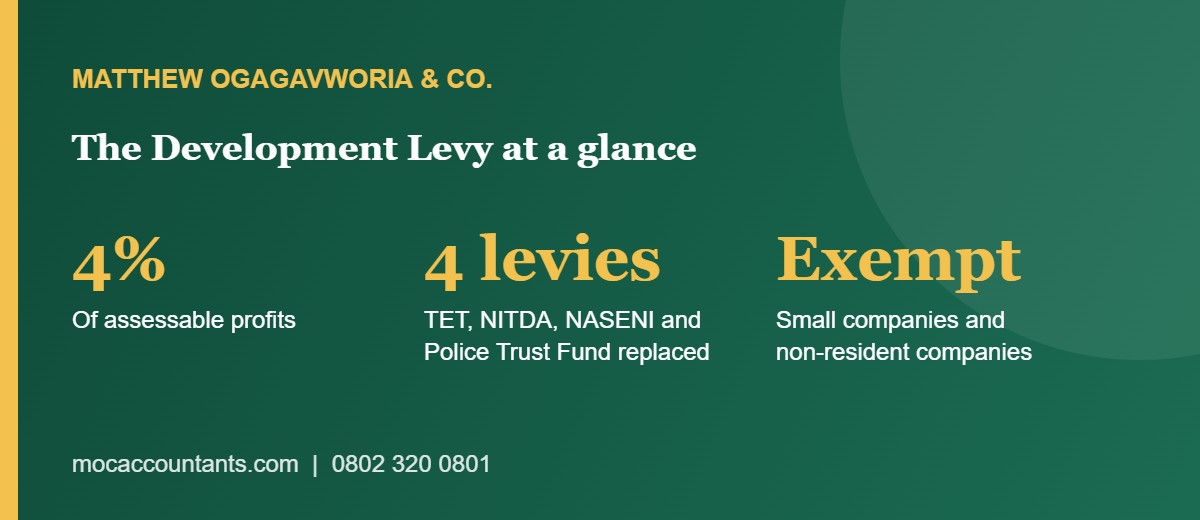
The Nigeria Tax Act 2025 swept away a collection of earmarked levies that companies had paid for years, each with its own rate, base, agency and filing process. In their place it introduced a single Development Levy of 4% on the assessable profits of companies, with exemptions for small companies and non-resident companies.
For many companies, the change simplifies compliance. For some, it increases the cost. For all, the first returns under the new levy fall due in 2027, covering financial years that began on or after 1 January 2026. Finance teams that have not yet modelled the levy, built it into tax provisions and updated their year-end close procedures should do so now.
This guide explains who pays the Development Levy, how to compute it, how it compares with the levies it replaced, and the practical steps for the December 2026 year end.
What the Development Levy replaced
Before 2026, a typical Nigerian company could face several profit-based levies on top of company income tax:
| Former levy | Typical rate | Base | Who paid |
|---|---|---|---|
| Tertiary Education Tax | 3% | Assessable profit | Most Nigerian companies |
| NITDA levy | 1% | Profit before tax | Specified companies, including banks, telecoms, insurance, ICT and pension firms, above a turnover threshold |
| NASENI levy | 0.25% | Profit before tax | Specified sectors including banking, telecoms, oil and gas and ICT |
| Police Trust Fund levy | 0.005% | Net profit | Companies operating in Nigeria |
Each levy had different rules and collection arrangements. Companies in regulated sectors could pay all four.
The Nigeria Tax Act 2025 consolidated these into the Development Levy. Proceeds are shared among the beneficiary funds and agencies named in the Act, including education and technology funds. For the paying company, there is now one levy, one rate and one computation.
Who pays
The Development Levy applies to companies chargeable to tax under the Act, with two main exemptions:
- Small companies as defined in the Act. These are companies with turnover and fixed assets within the statutory limits that do not provide professional services. Qualifying small companies also pay 0% company income tax.
- Non-resident companies.
A company that qualified as small in 2026 but grows beyond the limits in 2027 becomes liable to both company income tax at the standard rate and the Development Levy. Plan for that transition.
Note that the small company definition excludes businesses providing professional services, whatever their size. A small consultancy, law firm or accounting practice is likely to pay the levy.
How to compute the levy
The levy is 4% of assessable profits. Assessable profit is the company’s profit adjusted for tax purposes under the Act, before capital allowances.
The basic steps are:
- Start with accounting profit before tax from the financial statements.
- Add back disallowable expenses, such as depreciation, general provisions, fines, penalties and expenses not incurred wholly and exclusively for the business.
- Deduct non-taxable income and allowable items not in the accounts.
- Arrive at adjusted profit, then apply any loss relief permitted by the Act to reach assessable profit.
- Apply 4% to assessable profit.
Because the base is before capital allowances, a company that pays little or no company income tax because of large capital allowances may still pay a substantial Development Levy.
Worked examples
Example 1: a manufacturer
A Lagos manufacturer reports profit before tax of ₦420 million for 2026. Depreciation of ₦110 million and non-deductible expenses of ₦20 million are added back, giving adjusted and assessable profit of ₦550 million. Capital allowances are ₦180 million, so total profit for company income tax is ₦370 million.
- Development Levy: 4% × ₦550 million = ₦22 million.
- Under the old regime, Tertiary Education Tax at 3% on the same base would have been ₦16.5 million. The manufacturer was not in the NITDA or NASENI sectors.
- Increase: ₦5.5 million a year.
Example 2: a telecoms services company
A telecoms services company reports profit before tax of ₦1 billion and assessable profit of ₦1.2 billion.
- Development Levy: 4% × ₦1.2 billion = ₦48 million.
- Under the old regime, it could have paid Tertiary Education Tax of ₦36 million, NITDA levy of ₦10 million and NASENI levy of ₦2.5 million, a total of about ₦48.5 million on mixed bases.
- Effect: roughly neutral in cost, with much simpler compliance.
Figures are illustrative. Your computation depends on your adjustments and the detailed rules of the Act.
The Development Levy and company income tax together
The levy sits alongside company income tax. Companies that are not small pay company income tax at the standard rate under the Act plus the 4% Development Levy. Large companies and members of large multinational groups also need to consider the minimum effective tax rate rules introduced by the Act. Model the combined effect when you budget and when you evaluate investments.
For businesses near the small company limits, the jump from 0% company income tax and no levy to the full standard rate plus 4% is significant. A company with ₦30 million of assessable profit that crosses the limit could face a tax and levy bill running into millions of naira in a single year.
Accounting for the levy
Under IFRS, the Development Levy is a tax based on taxable profit. Most companies will present it within income tax expense under IAS 12, consistent with how Tertiary Education Tax was treated. Agree the presentation with your auditor and apply it consistently.
At year end:
- Accrue the current year levy in the tax provision.
- Reflect the levy in effective tax rate reconciliations.
- Consider deferred tax implications where the levy base differs from the accounting base in ways that reverse.
- Disclose the change in the tax regime and its effect on the tax charge.
Filing and payment
The levy is administered by the Nigeria Revenue Service alongside company income tax. File it with the company’s annual tax return by the due date under the Nigeria Tax Administration Act, generally within six months after the end of the accounting period. Pay on time to avoid penalties and interest.
Keep the computation, supporting adjustments and evidence of payment on file. The levy will be part of any tax audit.
Year-end action list for December 2026
- Confirm whether the company is a small company for 2026 under the Act’s definition. Document turnover, fixed assets and business activity.
- Model the 2026 levy using management accounts and the expected year-end adjustments.
- Update tax provisions in the December accounts for both company income tax and the levy.
- Stop accruing the old levies for periods covered by the new regime, and clear any old balances correctly.
- Update the tax computation template to calculate assessable profit, the levy and company income tax together.
- Brief the board on the effect on the tax charge and cash flow.
- Plan cash for payment when the 2026 return falls due in 2027.
Common mistakes
- Continuing to accrue Tertiary Education Tax, NITDA and NASENI levies after the new regime took effect.
- Computing the levy on profit after capital allowances instead of assessable profit.
- Assuming a professional services firm is exempt because its turnover is small.
- Ignoring the levy in investment appraisals and pricing.
- Leaving the levy out of the effective tax rate reconciliation.
Companies with non-December year ends
Not every company closes on 31 December. Banks and most listed companies do, but many subsidiaries of foreign groups close on 31 March or 30 June to match their parents. For these companies, the transition needs care. Identify which accounting periods fall under the old levies and which fall under the Development Levy, based on the commencement rules in the Act. Where a period straddles the change, take advice on how to compute and apportion each charge. Document the approach so that auditors and tax inspectors can follow it.
Groups of companies
The Development Levy applies to each company separately. There is no group relief that lets a profitable subsidiary offset a loss-making sister company. Groups should:
- Compute the levy for each company in the group.
- Review whether any group company qualifies as small and is therefore exempt.
- Check that intercompany charges, such as management fees and interest, are priced at arm’s length under the transfer pricing rules, because they shift assessable profit between companies.
- Consolidate the levy into the group tax charge and effective tax rate reconciliation.
The levy in pricing and investment decisions
A 4% charge on assessable profit affects returns. Include it when you:
- Price long-term contracts. Contracts priced in 2025 may not reflect the higher levy cost for companies that previously paid only Tertiary Education Tax.
- Appraise new investments. Use after-tax cash flows that include company income tax and the levy.
- Compare locations. Some free zone and incentive regimes change the overall tax burden. Model the levy alongside incentives before committing capital.
- Plan dividends. The levy reduces distributable cash. Factor it into dividend forecasts.
Questions to ask your tax adviser
Before you finalise the 2026 accounts, ask:
- Does the company qualify as a small company for 2026, and on what evidence?
- What adjustments take accounting profit to assessable profit for the levy?
- How should old levy balances on the balance sheet be cleared?
- How should the levy be presented in the financial statements?
- What is the combined effective tax rate after company income tax and the levy?
- Are there incentives or exemptions under the Act that affect the levy base?
Clear answers now prevent restatements and disputes later.
Records to keep for the levy
Keep these documents for at least six years to support the levy computation in a tax audit:
- The audited financial statements and trial balance.
- The full tax computation showing each adjustment to accounting profit.
- Schedules of disallowed expenses and non-taxable income.
- Loss relief workings, where applicable.
- Evidence that the company did or did not meet the small company tests.
- Filed returns and evidence of payment.
Tax inspectors will test the adjustments first. Clear workings shorten the audit and reduce the chance of an inflated assessment.
Frequently asked questions
What is the Development Levy in Nigeria?
A levy of 4% on the assessable profits of companies, introduced by the Nigeria Tax Act 2025. It replaced several earmarked levies, including the Tertiary Education Tax, NITDA levy, NASENI levy and Police Trust Fund levy.
Who is exempt from the Development Levy?
Small companies as defined in the Nigeria Tax Act 2025 and non-resident companies. Businesses providing professional services do not qualify as small companies.
Is the Development Levy calculated before or after capital allowances?
Before. The levy is charged on assessable profit, which is the tax-adjusted profit before capital allowances.
When is the Development Levy paid?
It is filed and paid with the company’s annual tax return to the Nigeria Revenue Service, generally within six months after the end of the accounting period.
Does the levy cost more than the old levies?
It depends on the company. Companies that only paid Tertiary Education Tax at 3% generally pay more. Companies in sectors that paid all the old levies may see a similar total cost with simpler compliance.
Do groups pay the Development Levy per company?
Yes. Each company computes and pays the levy on its own assessable profit. There is no group relief for the levy.
How Matthew Ogagavworia & Co. can help
Matthew Ogagavworia & Co. (Chartered Accountants) prepares tax computations, models the Development Levy and company income tax under the Nigeria Tax Act 2025, reviews tax provisions for year-end accounts, and files returns with the Nigeria Revenue Service. See our tax consulting and deferred tax services.
Get your 2026 tax position right: call 0802 320 0801 or 0807 576 5799, email enquiry@mocaccountants.com, or visit mocaccountants.com/contact.
This article is general information, not tax advice. Confirm the detailed rules with your adviser.








Facebook Comments