Ask a Nigerian finance manager for the company’s fixed asset register and you will often get one of three answers. Some produce a clean, reconciled register that matches the ledger. Many produce a spreadsheet last updated three years ago. A surprising number say the company does not have one, and that assets are tracked through the general ledger alone.
Without a reliable register, a company cannot prove what it owns, where its assets are, or whether depreciation and capital allowances are correct. Auditors cannot verify a balance that often runs into billions of naira. Tax authorities question capital allowance claims. Insurers pay out on the wrong values. And assets disappear without anyone noticing.
This guide explains what a good fixed asset register contains, how to carry out a physical verification and tagging exercise, how to reconcile the results, and why the effort pays back quickly.
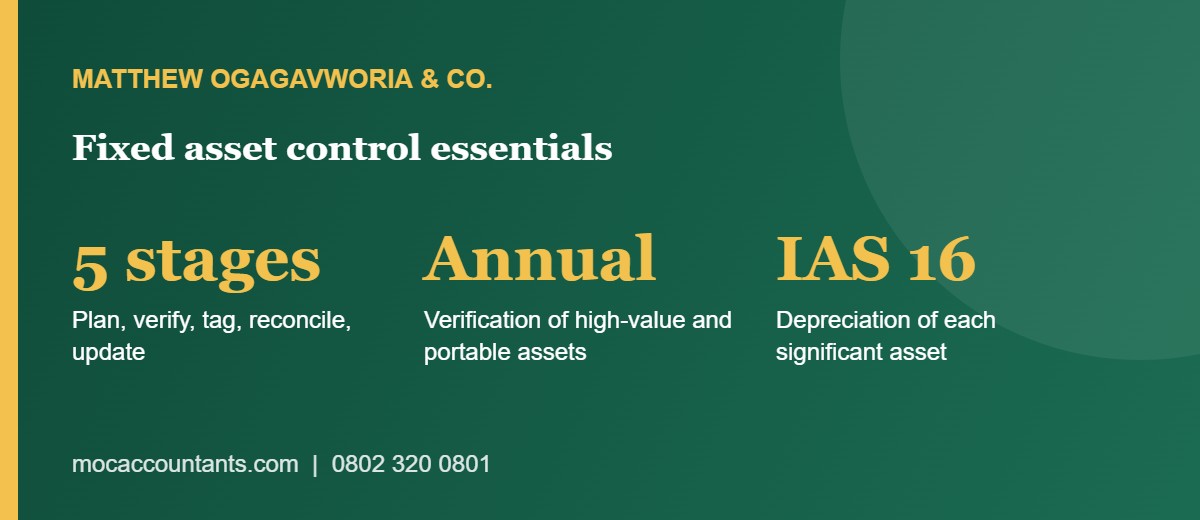
Fixed asset register and verification essentials.
What a fixed asset register is
A fixed asset register is a detailed list of every item of property, plant and equipment the company owns or controls. Where the general ledger shows totals by category, the register shows each asset individually.
A complete register records, for each asset:
Field
Purpose
Unique asset number and tag
Links the physical item to the record
Description, make, model and serial number
Identifies the item
Category
Land, buildings, plant, motor vehicles, furniture, IT equipment
Location and custodian
Shows where the asset is and who is responsible
Date of acquisition and supplier
Supports cost and ownership
Cost, including directly attributable costs
Basis for depreciation and capital allowances
Useful life, residual value and depreciation method
Basis for IAS 16 depreciation
Accumulated depreciation and net book value
Carrying amount in the accounts
Tax category and capital allowance claimed
Supports the tax computation
Condition and status
In use, idle, damaged, held for sale
Disposal date, proceeds and gain or loss
Records the end of the asset’s life
The register should reconcile to the general ledger at every reporting date.
Why it matters
Audit evidence
Auditors test the existence, ownership, valuation and completeness of fixed assets. A register lets them select assets and inspect them, and trace items on the floor back to the books. Without it, auditors may be unable to obtain sufficient evidence, and a modified opinion becomes possible where the balance is material.
IAS 16 requires depreciation of each significant part of an asset over its useful life. Ledger-level depreciation often continues on assets long since scrapped or sold, and misses assets still in use. A register corrects both.
Capital allowances and tax
Capital allowances reduce taxable profit. Tax inspectors ask for evidence of cost, date of acquisition and use in the business. A register with supporting invoices makes claims easy to defend. Under the Nigeria Tax Act 2025, accurate capital allowance claims remain important for company income tax, even though the 4% Development Levy is charged on profit before capital allowances.
Insurance
Insurers set premiums and settle claims based on declared values. Under-insured assets lead to reduced payouts. Insuring assets that no longer exist wastes premiums.
Loss prevention
Laptops, generators, vehicles, tools and air conditioners go missing in many organisations. Tagging and periodic verification deter theft and identify losses early.
Financing and transactions
Lenders take security over assets and want to know what exists. Buyers and investors in due diligence ask for the register. A clean register speeds up loans, sales and mergers.
The physical verification and tagging exercise
Companies that have not maintained a register for some time usually need a full verification exercise. It has five stages.
1. Planning
Extract the current asset listing from the ledger or old register.
List all locations: offices, warehouses, factories, branches, sites and staff homes where company equipment is used.
Agree asset categories, capitalisation threshold and tagging approach.
Assign teams and schedule visits.
2. Physical verification
Teams visit each location and record every asset found: description, serial number, condition, location and custodian. They photograph significant items. They also record assets found on site but not on the listing, and list items on the listing that cannot be found.
3. Tagging
Each verified asset receives a durable tag with a unique number, usually a barcode or QR code. Tags should be placed consistently, for example on the back of monitors or the inside of vehicle doors, so future verifications are quick. For assets that cannot take tags, such as land and buildings, use document references instead.
4. Reconciliation
Match the physical findings against the ledger listing:
Found and recorded: update details and confirm.
Recorded but not found: investigate. The asset may have been disposed of, moved, stolen or never existed. Write off after approval.
Found but not recorded: investigate. The asset may have been expensed instead of capitalised, donated or recorded under the wrong category. Capitalise where appropriate.
Recalculate depreciation from the verified data. Where historical cost records are missing, consider a valuation by a qualified valuer to establish deemed cost, with your auditor’s agreement. Update the register and the ledger, and document every adjustment.
A worked example
A Lagos manufacturer carried fixed assets of ₦3.1 billion at cost in its ledger. It had not verified assets for six years.
The verification team visited the factory, head office, two depots and the managing director’s residence. They found:
Assets costing ₦410 million on the ledger could not be found. Most had been scrapped or sold years earlier without recording disposals.
Assets with an estimated value of ₦96 million were in use but not on the ledger, mostly IT equipment and tools expensed in error.
Several generators and vehicles were recorded in the wrong categories, so the wrong depreciation rates had been applied.
Fourteen laptops issued to staff who had left could not be traced.
The company wrote off the missing assets after board approval, capitalised the unrecorded items that met its policy, corrected categories and depreciation, recovered six laptops, and introduced exit procedures that require return of company equipment. Its auditors removed a long-standing management letter point, and its insurer revised the policy to reflect actual assets.
Figures are illustrative.
Keeping the register up to date
A one-off clean-up is wasted if the register decays again. Build these controls into normal processes:
Capitalisation policy. Set a clear threshold and rules for what to capitalise.
Acquisition process. Finance records new assets in the register when invoices are processed, and issues tags on delivery.
Transfers. Require a transfer form when assets move between locations or custodians.
Disposals. Require approval, documentation of proceeds and removal from the register.
Periodic verification. Verify high-value and portable assets annually, and all assets at least every two to three years.
Monthly reconciliation. Reconcile the register to the ledger every month.
Exit procedures. Recover company assets from departing staff before final pay.
Common mistakes
Treating the general ledger as a substitute for a register.
Depreciating assets that no longer exist.
Expensing items that should be capitalised, or capitalising repairs that should be expensed.
Tagging assets without recording the tags in the register.
Ignoring assets at remote sites, branches or staff homes.
Writing off missing assets without investigation or approval.
Choosing a capitalisation threshold
A capitalisation threshold sets the minimum cost for an item to be recorded as a fixed asset. Below it, items are expensed. The right threshold balances accuracy with effort. Too low, and the register fills with staplers and chairs. Too high, and significant assets disappear into expenses.
Many mid-sized Nigerian companies set thresholds between ₦100,000 and ₦500,000, with exceptions for portable items such as laptops and phones, which are tracked whatever their cost because they are easy to lose. Set the threshold in a written policy, apply it consistently, and review it every few years as prices change. With inflation running above 14% in 2026, thresholds set five years ago may now capture items that are not significant.
IAS 16 requires significant parts of an asset with different useful lives to be depreciated separately. A factory building, its roof, its lifts and its generator have different lives. A vessel’s hull and its engines wear out at different rates. Recording major assets as a single item overstates or understates depreciation.
During a verification exercise, identify major assets that should be split into components. Use engineering input to estimate the cost and useful life of each part. This improves the accuracy of depreciation and makes replacement accounting easier when a component is renewed.
Assets under construction
Projects in progress, such as new buildings, plant installations or IT systems, are recorded as capital work in progress until ready for use. Common problems include:
Completed projects left in work in progress for years, so depreciation never starts.
Costs that should be expensed, such as training and general overheads, capitalised into projects.
No reconciliation between project budgets, invoices and the work in progress balance.
Review the work in progress balance at each year end. Transfer completed items to the correct asset category and start depreciation from the date each asset was available for use.
Impairment checks
IAS 36 requires companies to assess at each reporting date whether there are signs that assets may be impaired. Signs include physical damage, idle plant, a sharp fall in demand for products the asset makes, or a major adverse change in the business environment. Idle generators, abandoned projects and outdated machinery found during verification may need impairment testing. Record impairments with board approval and disclose them in the financial statements.
Assets held by staff and third parties
Laptops, phones, tools and vehicles often sit with staff at home or on the road. Generators and equipment may be at customer sites or with contractors. Record the custodian for each such asset, require signed acknowledgement when assets are issued, and verify them through scheduled check-ins or photo confirmation with serial numbers. Recover them when staff leave or contracts end.
Frequently asked questions
What is a fixed asset register?
A detailed record of each item of property, plant and equipment owned or controlled by a company, showing its description, location, cost, depreciation and status, reconciled to the general ledger.
How often should fixed assets be physically verified?
High-value and portable assets should be verified at least annually. All assets should be verified every two to three years, and whenever there is a major change such as a merger or relocation.
What should we do with assets on the register that cannot be found?
Investigate whether they were disposed of, moved or stolen. Write them off only after investigation and approval, and correct the depreciation and tax records.
Why do auditors ask for the fixed asset register?
Auditors use it to test that recorded assets exist, belong to the company, are correctly valued and that all assets owned are recorded.
Can we tag assets ourselves?
Yes, but an independent team brings objectivity, speed and experience in reconciling results, especially for large or multi-location companies.
What capitalisation threshold should a Nigerian company use?
Many mid-sized companies use thresholds between ₦100,000 and ₦500,000, tracking portable items such as laptops whatever their cost. Set the threshold in a written policy and review it as prices change.
How Matthew Ogagavworia & Co. can help
Matthew Ogagavworia & Co. (Chartered Accountants) carries out fixed asset verification, tagging and register build-outs for companies across Nigeria. We reconcile results to the ledger, correct depreciation and capital allowance records, and design controls that keep the register current. See our fixed assets management services and statutory audit services.
Book an asset verification: call 0802 320 0801 or 0807 576 5799, email enquiry@mocaccountants.com, or visit mocaccountants.com/contact.
This article is general information, not a substitute for advice on your own facts.










Facebook Comments