


Directors sign financial statements on the basis that the company will keep trading for the foreseeable future. That assumption, the going concern basis, sits behind every number in the balance sheet. When it fails, assets are written down to what they would fetch in a forced sale and liabilities fall due at once.
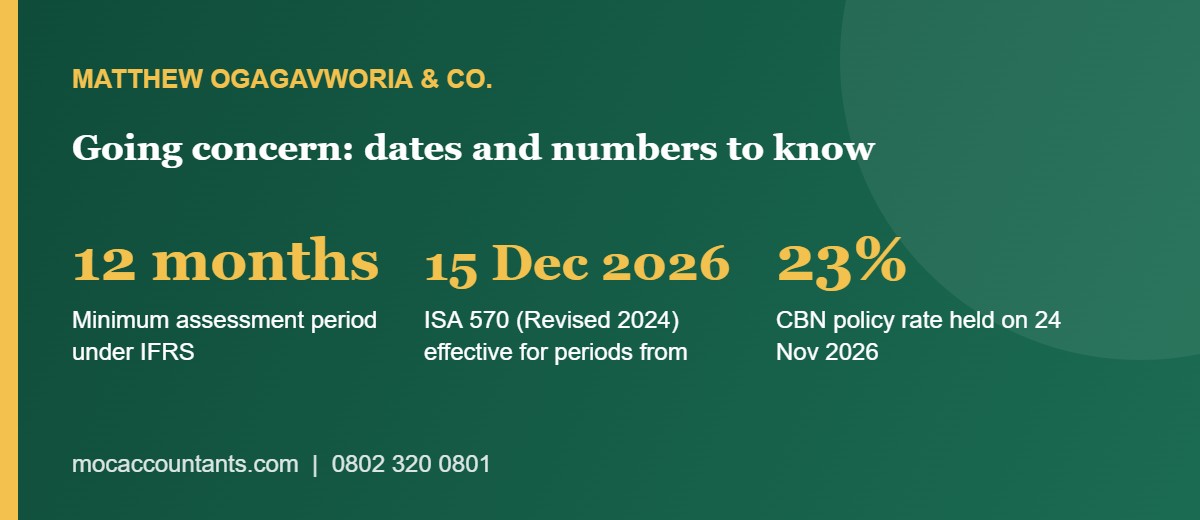
Nigerian companies face real pressure on this assumption. The Central Bank of Nigeria cut the monetary policy rate from 26.5% to 23% in September 2026 and held it at 23% on 24 November 2026. Borrowing is cheaper than a year ago but still expensive. A September 2026 report named nine companies listed on the Nigerian Exchange with negative shareholders’ funds. Many private companies carry similar strain without public scrutiny.
The audit standard is also changing. The International Auditing and Assurance Standards Board approved ISA 570 (Revised 2024) in April 2025. It applies to audits of periods beginning on or after 15 December 2026 and raises the bar for both management and auditors.
This guide explains what the rules require, how to prepare a going concern assessment that stands up to audit, and what happens when doubts arise.
What the accounting standards require
Under IFRS, management must assess whether the company can continue as a going concern. The requirement sat in IAS 1 paragraphs 25 and 26. IFRS 18, effective for periods beginning on or after 1 January 2027, moves the same text into IAS 8 paragraphs 6K and 6L without changing its substance.
| Requirement | What it means |
|---|---|
| Assessment | Management assesses the company’s ability to continue as a going concern |
| Period | At least 12 months from the end of the reporting period, longer where relevant |
| Material uncertainty | Disclose events or conditions that cast significant doubt |
| Not a going concern | Do not use the going concern basis, disclose the fact, reasons and basis used |
| Significant judgement | Disclose close-call judgements even where no material uncertainty exists |
The 12 months is a minimum. If a large loan matures 14 months after year-end, management must consider it.
What ISA 570 (Revised 2024) changes for auditors
The revised standard strengthens the auditor’s work in five areas.
- Earlier risk assessment. The auditor identifies going concern events or conditions as part of the main risk assessment.
- Evaluation in every audit. The auditor must evaluate management’s assessment even when no events or conditions point to doubt. That includes the method, key assumptions, data and possible management bias.
- Longer period. The auditor’s evaluation covers at least 12 months from the date the financial statements are approved, not from the reporting date.
- Clearer reporting. The auditor’s report describes the auditor’s responsibilities and work on going concern more fully.
- Stronger communication. The auditor communicates more with those charged with governance and, where required, with external parties.
For a December 2026 year-end, the revised standard does not yet apply. For a December 2027 year-end, it does. Directors should start building better assessments now.
Warning signs auditors look for
| Category | Examples |
|---|---|
| Financial | Net current liabilities, negative equity, recurring losses, negative operating cash flow, breached covenants, loans due with no refinancing |
| Operating | Loss of a key customer, supplier or licence, shortages of raw materials, exit of key management |
| External | Foreign exchange shortages, regulatory changes, litigation, sector collapse |
| Behavioural | Delayed payments to tax authorities and staff, frequent overdraft limit breaches, reliance on director loans |
Late remittance of PAYE, pension and withholding tax is a strong signal in Nigeria. It often appears months before formal default.
How directors should prepare the assessment
- Build a cash flow forecast. Cover at least 12 months from the expected approval date of the financial statements. Use monthly periods.
- State the assumptions. Record sales volumes, prices, collection days, supplier terms, interest rates and exchange rates. Use current data such as the 23% policy rate and the official naira rate of about N1,350 to N1,380 per dollar in mid-November 2026.
- Map debt maturities. List every facility, its maturity, covenants and refinancing plans.
- Run sensitivities. Test a 15% fall in sales, a 30-day slower collection cycle and a 10% weaker naira.
- Identify mitigating actions. List realistic steps such as cost cuts, asset sales, new equity or rescheduled debt. Show evidence that each is feasible.
- Document board review. Minute the board’s discussion, challenge and conclusion.
- Draft disclosures early. Agree the wording with the auditor before the year-end rush.
The Nigerian legal backdrop
CAMA 2020 gives directors reasons to take the assessment seriously.
- Section 572 sets the test for a company’s inability to pay its debts in a court winding-up. The debt threshold was amended by the Business Facilitation (Miscellaneous Provisions) Act and is now set by regulation.
- Section 672 allows personal liability where business is carried on recklessly or with intent to defraud creditors.
- Section 674 allows the court to assess damages against delinquent directors.
- Rescue tools include company voluntary arrangements (section 434), administration (sections 443 to 444) and arrangements and compromises (sections 711 to 717).
A director who keeps trading and taking credit while the company cannot pay faces real personal risk. An early, honest assessment protects directors as well as creditors.
Worked example
This example is illustrative. The company and figures are invented.
Akure Packaging Limited makes cartons for food producers. Its December 2026 accounts show revenue of N6.2 billion, a loss of N410 million and net current liabilities of N780 million. A N1.5 billion term loan matures in October 2027. The bank has signalled willingness to refinance only after seeing audited accounts.
Management prepares a 15-month cash flow forecast to March 2028.
| Scenario | Lowest cash point | Month |
|---|---|---|
| Base case | N95 million | September 2027 |
| Sales down 15% | Negative N210 million | August 2027 |
| Collections 30 days slower | Negative N340 million | July 2027 |
Management identifies mitigating actions. It agrees a N300 million standby facility from its main shareholder, signs a term sheet to sell an idle warehouse for about N400 million and starts refinancing talks.
The auditor concludes that the going concern basis is appropriate. Because refinancing is not yet agreed and the downside cases show cash shortfalls, it judges that a material uncertainty exists. The financial statements disclose the loan maturity, the forecast results and the mitigating actions. The audit report includes a “Material Uncertainty Related to Going Concern” section. The opinion remains unmodified.
Without the forecast and documented mitigations, the auditor could have issued a qualified or adverse opinion, and the bank would likely have refused to refinance.
The board’s role
Going concern is a board responsibility, not a finance department task. Directors approve the financial statements and confirm the basis of preparation. They should see the evidence, not only the conclusion.
A good board pack on going concern includes:
- A summary of the cash flow forecast and lowest cash points.
- A schedule of debt maturities and covenant headroom.
- The sensitivity results and what would trigger a shortfall.
- A list of mitigating actions with evidence and owners.
- Management’s proposed conclusion and draft disclosure.
- The auditor’s emerging view, where available.
The audit committee should challenge assumptions and record that challenge in its minutes. Under the revised ISA 570, auditors will look for evidence that those charged with governance engaged with the assessment.
Working with lenders during uncertainty
Banks read the going concern note closely. A company that surprises its lender with a material uncertainty paragraph damages trust. One that engages early often keeps its facilities.
- Share the cash flow forecast with your relationship manager before the audit closes.
- Request covenant waivers before the test date, not after a breach.
- Agree refinancing terms in writing where possible, so the auditor can rely on them.
- Explain the mitigating actions and the timeline for each.
- Keep statutory payments current. Lenders treat tax and pension arrears as a red flag.
When the answer is no
Sometimes the honest conclusion is that the company cannot continue. Directors should then take insolvency advice at once. CAMA 2020 offers company voluntary arrangements and administration as rescue routes before liquidation. Acting early preserves more value for creditors, staff and shareholders, and reduces the personal risk to directors under section 672. The financial statements must then be prepared on a basis other than going concern, with full disclosure of the reasons.
Going concern and tax exposure
Tax issues can trigger or deepen going concern doubts. A large unexpected assessment from the Nigeria Revenue Service, unpaid withholding tax or PAYE with penalties and interest, or a dispute before the Tax Appeal Tribunal can all affect cash flow. Include known and likely tax liabilities in the forecast. Where a material assessment is under objection, disclose it and model the cash effect if the objection fails.
A going concern timetable for December year-ends
Plan the work so it does not collide with the audit deadline.
| Timing | Action |
|---|---|
| October | Finance builds the first draft of the 12 to 15 month cash flow forecast |
| November | Run sensitivities and list mitigating actions with owners |
| December | Board reviews the draft assessment and approves next steps |
| January | Update the forecast with year-end actuals and confirm loan positions with banks |
| February | Share the assessment and evidence with the auditor |
| March | Finalise disclosures and board minutes before the financial statements are approved |
If the approval date slips, extend the forecast so it still covers at least 12 months from approval. Under the revised ISA 570, the auditor will measure from that date. A late signing with a short forecast creates an avoidable finding.
Keep the forecast alive after the audit. Update it monthly and compare actual cash with forecast. A company that tracks its forecast through the year will find the next assessment far easier and will see trouble early enough to act.
Common mistakes
- Starting the assessment after the auditor asks for it.
- Using a forecast period that ends 12 months after year-end instead of covering the full required period.
- Relying on optimistic sales growth with no evidence.
- Ignoring loan covenants and maturity dates beyond the forecast window.
- Listing mitigating actions with no proof they can happen.
- Omitting disclosure of close-call judgements.
- Delaying payment of statutory deductions to save cash, which adds penalties and signals distress.
- Treating a material uncertainty paragraph as a disaster. Clear disclosure often protects credibility with lenders.
Frequently asked questions
What is the going concern assessment period under IFRS?
Management must cover at least 12 months from the end of the reporting period. Under ISA 570 (Revised 2024), the auditor evaluates at least 12 months from the date the financial statements are approved.
When does ISA 570 (Revised 2024) take effect?
It applies to audits of financial statements for periods beginning on or after 15 December 2026. For most Nigerian companies with December year-ends, that means the 2027 financial statements.
Does a material uncertainty paragraph mean a qualified audit opinion?
No. If management discloses the uncertainty adequately, the auditor issues an unmodified opinion with a separate section on the material uncertainty. A qualified or adverse opinion follows only if disclosure is inadequate or the going concern basis is inappropriate.
Can directors be personally liable if a company trades while insolvent?
Section 672 of CAMA 2020 allows the court to hold persons personally liable where business was carried on recklessly or with intent to defraud creditors. Directors should take advice early when solvency is in doubt.
What evidence supports mitigating actions?
Signed facility letters, board resolutions, term sheets for asset sales, shareholder commitment letters and correspondence with lenders. Plans without documents carry little weight with auditors.
How Matthew Ogagavworia & Co. can help
Matthew Ogagavworia & Co. is a firm of chartered accountants providing statutory audit, internal audit, tax, payroll and valuation services across Nigeria. For companies under pressure, we review cash flow forecasts, test assumptions, prepare going concern papers for boards and auditors, and advise on disclosures. Where we are not your auditor, we can act as an independent adviser to the board.
Learn more about our statutory audit services, financial models development and corporate reorganisation advisory.
To prepare a going concern assessment before your year-end audit, call 0802 320 0801 or 0807 576 5799, email enquiry@mocaccountants.com, or visit our contact page.
Sources: IAASB on ISA 570 (Revised 2024), IFRS Foundation going concern educational material and ThisDay on the November 2026 MPC decision.
This article is general information at November 2026. It is not audit, legal or financial advice. Speak to a qualified adviser about your circumstances.








Facebook Comments