Withholding tax is the tax most Nigerian companies get wrong every month. A finance officer pays a supplier the full invoice, forgets to deduct 2%, and the company now owes the tax itself plus a 40% penalty. Another deducts correctly but remits late, and interest starts to run. A third remits on time but never issues the receipt, and the supplier cannot claim credit.
The rules changed twice in two years. The Deduction of Tax at Source (Withholding) Regulations 2024 took effect on 1 January 2025 with new rates and a small-business exemption. The Nigeria Tax Administration Act 2025 took effect on 1 January 2026 and replaced the old penalty regime with tougher sanctions. The Federal Inland Revenue Service is now the Nigeria Revenue Service (NRS).
This guide sets out the current rates, who must deduct, when to remit, how credit works and what the penalties are. It ends with a worked example and a checklist your accounts team can use from next month.
Sources: Deduction of Tax at Source (Withholding) Regulations 2024 and Nigeria Tax Administration Act 2025.
What withholding tax is
Withholding tax (WHT) is not a separate tax. It is an advance payment of income tax collected at source. The payer deducts a percentage from a payment to a supplier, landlord, consultant or investor and pays it to the tax authority. The recipient then uses the receipt as a credit against its own income tax.
For non-residents without a taxable presence in Nigeria, WHT is usually the final tax. Regulation 5 of the 2024 Regulations and section 51 of the Nigeria Tax Administration Act set out this treatment.
Section 51(1) of the Nigeria Tax Administration Act requires the deduction at the date of payment or settlement, whichever comes first. Offsetting a supplier invoice against a debt the supplier owes you counts as settlement.
The legal framework in 2026
Instrument
Effect
Deduction of Tax at Source (Withholding) Regulations 2024 (S.I. No. 34 of 2024)
Rates, exemptions and procedures, effective 1 January 2025
FIRS implementation circular, 24 February 2025
Practical guidance on the 2024 Regulations
Nigeria Tax Act 2025
Charging provisions for income tax
Nigeria Tax Administration Act 2025
Deduction duty, remittance, returns and penalties, effective 1 January 2026
Section 146(c) of the Nigeria Tax Administration Act keeps existing regulations in force unless they conflict with the Act. The 2024 Regulations therefore still set the rates. In September 2026 the Minister of Finance inaugurated a technical sub-committee whose mandate includes drafting new WHT regulations for 2027. No draft has been published, so the 2024 rates apply for now.
The table below shows the main rates under the 2024 Regulations. Rates are shown in the order resident company, non-resident company, resident individual, non-resident individual.
Transaction
Rates (%)
Dividends, interest
10 / 10 / 10 / 10
Royalties
10 / 10 / 5 / 5
Rent, hire and lease
10 / 10 / 10 / 10
Commission, consultancy, technical, management and professional fees
5 / 10 / 5 / 10
Supply of goods (other than by the manufacturer)
2 / not applicable / 2 / not applicable
Other services
2 / 5 / 2 / 5
Construction of roads, bridges, buildings and power plants
Missing TIN doubles the rate. Regulation 3(c) doubles the rate on goods, services and other non-passive income where the payee has no Tax Identification Number. The payer must record the payee’s NIN or RC number instead.
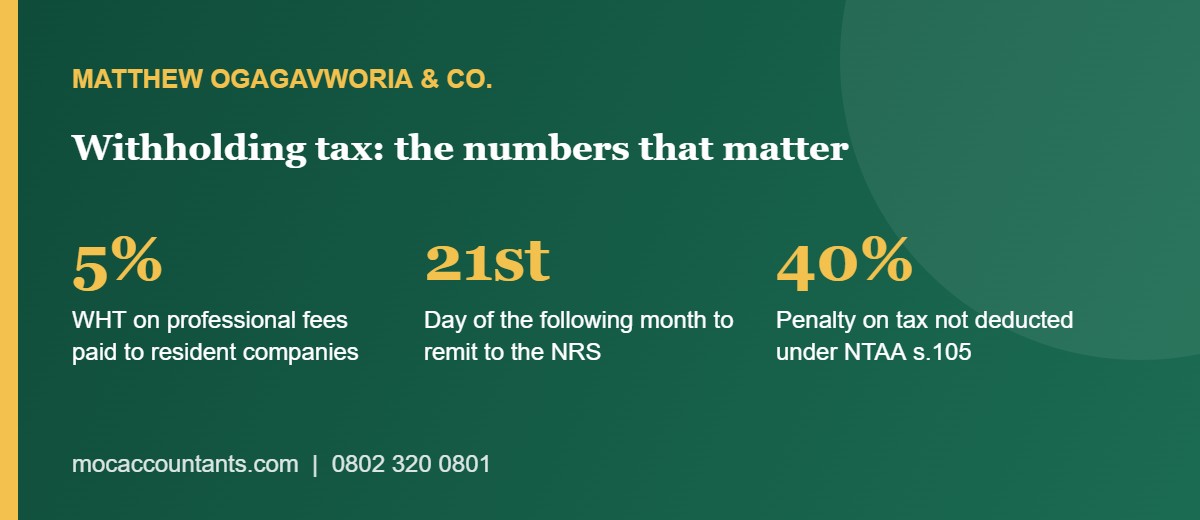
Professional fees dropped for residents. Consultancy and professional fees paid to resident companies now attract 5%, down from 10% under the old regime.
Supply of goods by the manufacturer is outside the table. A manufacturer selling its own products does not suffer the 2% deduction on goods.
The small company exemption
Regulation 4(2) exempts certain payers from deducting WHT. Read it carefully, because many commentators state it the wrong way round. The exemption belongs to the payer, not the supplier.
A payer does not need to deduct where all three conditions hold:
the payer is a small company or an unincorporated body with similar attributes
the supplier has a valid TIN
the transaction is worth ₦2,000,000 or less in the relevant calendar month
The 2024 Regulations defined a small company by reference to the Companies Income Tax Act, with turnover of ₦25 million or less. The Nigeria Tax Act 2025 has replaced that Act and uses its own definition. Confirm the current threshold with your adviser before relying on the exemption.
Who must deduct
Every company, government body, partnership and individual making a qualifying payment in the course of business must deduct. That includes:
companies paying rent for offices, warehouses and staff housing
companies paying consultants, auditors, lawyers and IT contractors
companies buying goods from distributors and traders
companies paying directors’ fees
companies paying dividends or interest
Payments to employees under PAYE are outside the WHT regime. They follow the PAYE rules.
Remittance, returns and receipts
Step
Requirement
Deduct
At the date of payment or settlement
Remit to NRS
By the 21st day of the month after payment (Regulation 7(1) and NTAA section 107(1))
Remit to state revenue service
Deduction from individuals and enterprises, by the deadline set under state law
File return
Monthly WHT return with schedule of payees
Issue receipt
Third Schedule format, showing payee, TIN, amount, rate and tax deducted
Company-to-company deductions go to the NRS. Deductions from individuals and unincorporated enterprises go to the relevant state internal revenue service.
Regulation 8(3) protects the payee. If the payer issues a receipt but fails to remit, the payee still gets the credit. The payer then owes the tax, the penalty and the interest.
The NRS launched its Rev360 portal on 30 April 2026 as the replacement for TaxPro Max. Rollout is phased, starting with medium and emerging taxpayers. Existing WHT credits migrate automatically. Check which portal applies to your taxpayer category before the next filing date.
The penalties under the 2025 Act
The Nigeria Tax Administration Act raised the cost of getting WHT wrong.
Failure
Consequence
Failure to deduct (section 105)
Administrative penalty of 40% of the amount not deducted
Deducted but not remitted by the due date (section 107(1))
Tax deducted, plus 10% per annum penalty, plus interest at the CBN monetary policy rate
Conviction for failure to remit (section 107(3))
Fine of at least the amount not remitted plus up to 50%, imprisonment of up to 3 years, or both
Officers of the company (section 126)
Directors and principal officers can face personal liability
The 40% penalty applies on top of the tax itself. A company that misses ₦1 million of deductions owes the ₦1 million plus ₦400,000, before interest.
Worked example
This example is illustrative. The company and figures are not drawn from a real client.
Adebayo Logistics Limited is a medium-sized company with a December year end. In March 2026 it makes the payments below. All payees are Nigerian companies with valid TINs, except one.
Payee
Nature
Gross (₦)
Rate
WHT (₦)
Landlord company
Office rent
6,000,000
10%
600,000
Audit firm
Professional fee
4,000,000
5%
200,000
Fuel distributor
Supply of diesel
9,000,000
2%
180,000
Haulage subcontractor
Other services
3,000,000
2%
60,000
IT contractor without TIN
Other services
1,500,000
4% (doubled)
60,000
Total
23,500,000
1,100,000
Adebayo Logistics must remit ₦1,100,000 to the NRS by 21 April 2026 and file the March return. It must issue five receipts so each payee can claim credit.
Now assume the accounts officer paid the diesel supplier in full and forgot the ₦180,000 deduction. Under section 105 the company owes the ₦180,000 plus a 40% penalty of ₦72,000. Total exposure on one invoice is ₦252,000 before interest, and the company cannot recover it from the supplier after the fact without a fight.
Assume instead that the company deducted the full ₦1,100,000 but remitted it on 30 June 2026. It still owes the tax, a penalty of 10% per annum on the late amount, and interest at the monetary policy rate for the period of delay.
WHT works in both directions. Your company deducts from suppliers, and your customers deduct from you. The receipts your customers issue are an asset. Each one reduces the income tax you pay when you file your annual return.
Many companies lose this asset. Customers deduct but never send receipts. The finance team books the short payment as a bad debt or a discount. At year end the company pays full income tax and leaves the credits unclaimed.
A simple routine prevents the loss:
When a customer pays less than the invoice, record the difference in a WHT receivable account, not as a discount.
Chase the customer for the receipt within 30 days.
Match each receipt to the invoice and to the WHT receivable balance.
Check that the credit appears on your NRS profile before you file the annual return.
Write off only the balances you cannot support after a documented follow-up.
Setting up WHT in your accounting system
Most errors start in the system, not with the accountant. Set up a tax code for each rate in the table and link each supplier record to its default code. Add a mandatory TIN field to the supplier master file and block payment where it is empty unless the doubled rate applies. Run a monthly report of payments made without a WHT code and review it before the remittance date. These controls cost little to build and remove most of the risk.
Common mistakes
Paying the gross invoice and promising to deduct later.
Applying 10% to professional fees for resident companies after the 2024 rate change.
Ignoring the doubled rate when a supplier has no TIN.
Treating the small company exemption as a supplier exemption.
Deducting WHT on goods bought from the manufacturer.
Remitting company deductions to the state or individual deductions to the NRS.
Failing to issue receipts, which leaves suppliers unable to claim credit and damages relationships.
Missing deductions on settlement by offset or barter.
Deducting but holding the money in a suspense account past the 21st.
Failing to reconcile WHT credit notes received against the receivables ledger.
A monthly WHT checklist
Before payment, confirm the payee’s TIN and the nature of the transaction.
Apply the correct rate from the 2024 table and double it where there is no TIN.
Deduct at the date of payment or settlement.
Record the deduction in a WHT payable account by payee.
Remit company deductions to the NRS and individual deductions to the state by the due date.
File the monthly return with a full payee schedule.
Issue Third Schedule receipts to every payee.
Reconcile WHT payable to the ledger and to remittance evidence each month.
Track WHT credit notes received from customers and apply them against your annual tax liability.
Frequently asked questions
What is the withholding tax rate on consultancy fees in Nigeria in 2026?
Consultancy, professional, technical and management fees paid to a resident company attract 5%. The rate for non-resident companies is 10%. The rate doubles where the payee has no Tax Identification Number.
When must withholding tax be remitted to the NRS?
Withholding tax deducted from companies must reach the NRS by the 21st day of the month after the payment. The deadline applies under Regulation 7(1) of the 2024 Regulations and section 107(1) of the Nigeria Tax Administration Act.
Is a small business exempt from withholding tax?
A small company payer need not deduct WHT where the supplier has a valid TIN and the transaction is ₦2,000,000 or less in the month. The exemption applies to the payer, not the supplier. Check the current small company definition under the Nigeria Tax Act before relying on it.
What happens if a company fails to deduct withholding tax?
Section 105 of the Nigeria Tax Administration Act imposes an administrative penalty of 40% of the amount not deducted. The company also remains liable for the tax itself.
Can a supplier claim credit if the customer deducted WHT but never remitted it?
Yes, if the customer issued a valid receipt. Regulation 8(3) gives the supplier credit, and the NRS pursues the customer for the tax, the penalty and the interest.
How Matthew Ogagavworia & Co. can help
Matthew Ogagavworia & Co. is a firm of chartered accountants serving Nigerian companies, NGOs and foreign-owned businesses. We run WHT health checks, map every supplier to the correct rate, prepare and file monthly returns, reconcile WHT credit notes and represent clients in NRS and state tax audits. Our team also handles statutory audit, payroll and PAYE, stock counts, fixed asset verification and company registration.
This article is general information based on laws and regulations in force at November 2026. It is not tax advice. Speak to a qualified adviser about your circumstances before acting.











Facebook Comments