VAT in Nigeria changed on 1 January 2026. The Nigeria Tax Act 2025 kept the rate at 7.5%, but it rewrote the rules on what you can recover, what is zero-rated and who must register at all.
For many businesses the biggest win is input VAT. You can now claim VAT paid on services and fixed assets, not only on goods bought for resale or production. For others the change hurts. Some items moved from exempt to zero-rated, and e-invoicing through the Nigeria Revenue Service (NRS) now tracks every taxable sale.
Year-end is the right moment to check your VAT position. Errors made in 2026 will surface in your first audit under the new law, and the NRS has more data on your transactions than ever.
This guide explains the VAT rules under the Nigeria Tax Act 2025 in plain terms. It covers the rate, the small company exemption, input VAT recovery, zero-rated and exempt supplies, monthly returns, e-invoicing and the penalties that apply.
Sources: Nigeria Tax Act 2025, Forvis Mazars and BDO summaries
The legal framework
Three laws now govern VAT in Nigeria.
The Nigeria Tax Act 2025 sets out what is taxable, the rate, exemptions, zero-rating and input VAT rules. It replaced the Value Added Tax Act.
The Nigeria Tax Administration Act 2025 sets out registration, filing, payment, audits and penalties.
The Nigeria Revenue Service (Establishment) Act 2025 created the NRS, which replaced the Federal Inland Revenue Service as the federal collector of VAT.
All three took effect on 1 January 2026. Any transaction from that date falls under the new rules.
What stayed the same
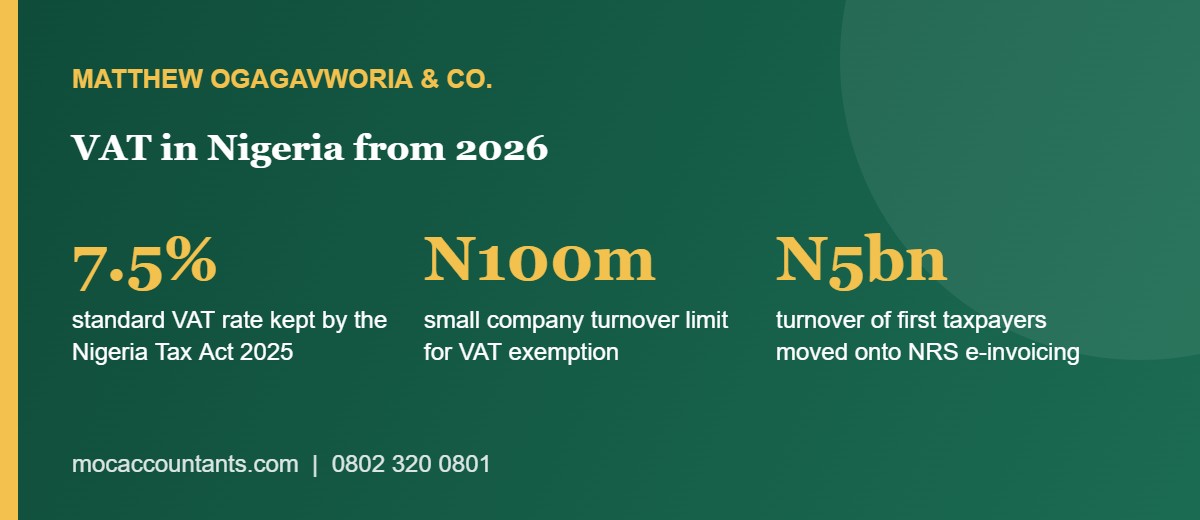
The standard VAT rate remains 7.5%. A proposal to raise it in phases to 15% by 2030 did not make it into the final law.
VAT is still a tax on consumption. Businesses charge output VAT on taxable supplies, deduct allowable input VAT, and remit the difference to the NRS. The final consumer bears the tax.
What changed: a summary
Area
Before 2026
Under the Nigeria Tax Act 2025
Standard rate
7.5%
7.5%
Input VAT on services
Not claimable
Claimable if linked to taxable supplies
Input VAT on fixed assets
Not claimable, capitalised
Claimable if linked to taxable supplies
Basic food, medical and educational items
Mostly exempt
Zero-rated
Small company relief
Turnover below N25 million
Turnover of N100 million or less and fixed assets of N250 million or less
E-invoicing
Not in force
Phased in through the NRS fiscalisation system
Collector
FIRS
NRS
The small company exemption
Under the new law, a small company does not need to register for, charge, file or remit VAT. Forvis Mazars, summarising the Act, sets the test as annual turnover of N100 million or less and total fixed assets not exceeding N250 million. Businesses that provide professional services do not qualify, whatever their size.
You cannot charge VAT if you are exempt. A small company that issues VAT-inclusive invoices is collecting tax it has no right to collect.
You cannot recover input VAT. The VAT you pay on purchases becomes a cost.
You can opt in. A small company may give written notice to opt out of the exemption. This suits businesses that sell mainly to large VAT-registered customers and want to recover input VAT on equipment and services.
Check the test every year. A company that crosses N100 million in turnover must register and start charging VAT.
Input VAT recovery: the biggest change
Before 2026, only VAT on goods bought for resale or used directly in production was recoverable. VAT on rent, professional fees, security services, software subscriptions, vehicles and machinery was a cost.
The Nigeria Tax Act 2025 widens recovery. You can now claim input VAT on services and fixed assets, provided they relate to taxable supplies. BDO notes that input VAT is deductible only to the extent it is attributable to taxable outputs.
What you can now recover
VAT on audit, legal and consulting fees
VAT on office rent and facility management
VAT on telecoms, internet and software subscriptions
VAT on generators, machinery, vehicles and IT equipment used in the taxable business
VAT on repairs and maintenance
The conditions
A valid VAT invoice. The invoice must show the supplier’s tax identification number, the VAT charged and your details. Under e-invoicing, the invoice must also pass through the NRS system.
A link to taxable supplies. Input VAT on exempt activities stays a cost.
Apportionment. If a cost serves both taxable and exempt activities, you must split the input VAT and recover only the taxable share.
A time limit. Forvis Mazars reports a five-year window to claim input VAT.
Refunds
When input VAT exceeds output VAT, you can request a refund. Forvis Mazars reports that refund claims must be filed within 12 months, the NRS must process them within 30 days, and refunds can be set off against other tax liabilities.
The difference matters. A zero-rated supply carries VAT at 0%, so the supplier can still recover input VAT. An exempt supply carries no VAT, and the supplier cannot recover input VAT on related costs.
Category
Treatment under the Nigeria Tax Act 2025
Basic food items
Zero-rated
Medical and pharmaceutical products and medical services
Zero-rated
Educational books and materials and tuition
Zero-rated
Agricultural inputs and products
Zero-rated
Electric vehicles and parts
Zero-rated
Goods and services purchased by diplomatic missions
Exempt
Assistive devices for persons with disabilities
Exempt
Petroleum products, CNG, LPG and renewable energy equipment
VAT suspended until a date set by the Minister of Finance
Moving from exempt to zero-rated helps food processors, pharmaceutical firms and schools. They can now recover input VAT they once absorbed. Check the full schedules in the Act before you change your billing, because the lists are detailed and exclusions apply. For example, BDO notes that water sold in restaurants, hotels and by caterers is taxable.
Monthly VAT returns and payment
VAT-registered businesses file a return every month and pay the net VAT due. Returns are due by the 21st day of the month after the month of the transactions.
Each return must show:
Total sales, split into taxable, zero-rated and exempt supplies
Output VAT charged
Input VAT claimed, with supporting invoices
VAT withheld at source by customers, if any
Net VAT payable or refundable
The Act also requires businesses to disclose the state where consumption took place. This feeds the distribution of VAT revenue among states. Forvis Mazars reports a N1,000,000 penalty for failing to disclose state-level consumption data.
VAT withholding
Some customers must withhold VAT from payments to suppliers and remit it directly to the NRS. BDO reports that withheld VAT must be remitted no later than the 14th day of the following month.
If your customer withholds VAT, collect the credit note or receipt and reconcile it against your output VAT. Unreconciled withholding is one of the most common errors we see in VAT audits.
E-invoicing and fiscalisation
The NRS is rolling out an electronic fiscalisation system, known as the Merchant Buyer Solution. Every taxable invoice passes through the system in real time and receives a validation code.
Forvis Mazars reports that large taxpayers with turnover of N5 billion and above moved first, with enforcement running from April to June 2026. Medium and emerging taxpayers follow.
Penalties are steep:
Failure
Penalty reported by Forvis Mazars
Denying the NRS access to deploy fiscalisation technology
N1,000,000 on the first day, then N10,000 per day
Not processing taxable supplies through the fiscalisation system
N200,000 plus 100% of the tax due plus interest at the CBN Monetary Policy Rate
Not disclosing state-level consumption data in returns
A Lagos manufacturer with N900 million annual turnover sells taxable goods. In March 2026 it records:
Item
Amount (N)
VAT at 7.5% (N)
Sales of taxable goods
80,000,000
6,000,000
Raw materials bought
30,000,000
2,250,000
Factory rent
4,000,000
300,000
Audit and legal fees
2,000,000
150,000
New packaging machine
20,000,000
1,500,000
Under the old rules, only the raw materials VAT of N2,250,000 was recoverable. Net VAT payable was N3,750,000.
Under the Nigeria Tax Act 2025, the company recovers VAT on raw materials, rent, fees and the machine. Total input VAT is N4,200,000. Net VAT payable falls to N1,800,000.
The monthly cash saving is N1,950,000. The company must hold valid invoices for each item and keep them for audit.
Year-end VAT checklist
Use this list before you close your 2026 books.
Reconcile VAT returns filed for January to November against your general ledger.
Confirm every input VAT claim on services and fixed assets has a valid invoice.
Apportion input VAT where costs serve both taxable and exempt activities.
Review your product list against the zero-rated and exempt schedules.
Reconcile VAT withheld by customers against credit notes.
Check whether you crossed or fell below the small company threshold.
Confirm your e-invoicing readiness and your expected migration date.
File any outstanding refund claim within the 12-month window.
Common mistakes to avoid
Charging VAT while exempt. A small company that charges VAT without registering creates a liability and confuses its customers.
Ignoring new input VAT rights. Many businesses still expense VAT on services and fixed assets out of habit. That money is now recoverable.
Claiming input VAT on exempt activities. Recovery applies only to taxable supplies. Over-claiming invites penalties and interest.
Treating zero-rated sales as exempt. Zero-rated sales still go on the return, and related input VAT is recoverable.
Missing the state disclosure. Returns without state-level consumption data attract a N1,000,000 penalty.
Poor invoice records. Without valid invoices, the NRS will disallow input VAT claims at audit.
Late registration. A business that crosses the threshold and keeps trading without registering builds up unpaid VAT plus penalties and interest.
Frequently asked questions
What is the VAT rate in Nigeria in 2026?
The standard VAT rate is 7.5%. The Nigeria Tax Act 2025 kept this rate. Zero-rated supplies, such as basic food, medical and educational items, carry VAT at 0%.
Can I claim input VAT on services and fixed assets now?
Yes. From 1 January 2026, input VAT on services and fixed assets is recoverable, provided it relates to taxable supplies and you hold a valid VAT invoice. Where a cost serves both taxable and exempt activities, you must apportion the input VAT.
Does my small business need to register for VAT?
A company with annual turnover of N100 million or less and fixed assets of N250 million or less is exempt from registering, charging and filing VAT, unless it provides professional services. It can opt in by written notice if it wants to recover input VAT.
When is the monthly VAT return due?
Monthly VAT returns are due by the 21st day of the month after the transactions. VAT withheld by customers must be remitted to the NRS by the 14th day of the following month.
What happens if I do not use the NRS e-invoicing system?
Failing to process taxable supplies through the fiscalisation system attracts a N200,000 penalty, plus 100% of the tax due and interest at the CBN Monetary Policy Rate. Large taxpayers moved first, and medium and emerging taxpayers follow.
How Matthew Ogagavworia & Co. can help
Matthew Ogagavworia & Co. is a firm of chartered accountants that helps Nigerian businesses comply with the new tax laws. We review your VAT position, recover input VAT you are entitled to, prepare monthly returns, reconcile withholding credits and prepare you for NRS e-invoicing and audits.
This article is general information and does not constitute tax advice. Confirm the position for your business with a qualified tax adviser before acting.











Facebook Comments